Two Kids from West Vancouver
Glen Sebastian Burns
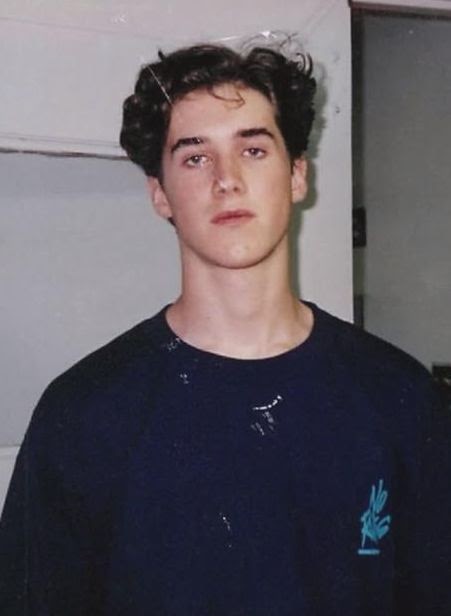
Glen Sebastian Burns grew up in West Vancouver in the kind of household the media never bothered to describe accurately. The Burns family lived in a bungalow in a typical West Vancouver neighbourhood — the kind of street that existed before the area became synonymous with the wealth it carries today. There was no estate. There was a family, a house, and a kid being raised to participate in the world around him.
And participate he did. Sebastian played cello from age five through twelve and performed with the Vancouver Youth Orchestra Summer Pops. He earned the Duke of Edinburgh Gold Medal. He sold poppies for Remembrance Day. He volunteered at book sales for the West Vancouver Library. From twelve to sixteen he was a member of the West Vancouver Pathfinder Royal Canadian Cadet Squadron — where he served as Sergeant Major and led the largest parade Vancouver had seen to that point, marking the 50th Anniversary of the Battle of Britain. He flew gliders and holds his glider's certificate. He biked to Oregon. He led outdoor survival training for other cadets.
He read Shakespeare. He read Harper's and The New Yorker. He was finishing his first year studying Arts at Capilano College when the summer of 1994 arrived.
He was eighteen years old. He was, by every measure, a young man building a life — earnest, engaged, and completely unaware that a summer trip to visit a friend's family would be the last ordinary thing he ever did.
Atif Rafay

Atif Rafay was born in 1976 and grew up between North Vancouver and Karachi, Pakistan, where his family lived from 1984 to 1989. He came back to Canada with a lifelong affection for cats, books, and what he himself described as excessive movie rentals. He was introduced to computers early and followed that interest toward cognitive science and philosophy of mind — the kind of intellectually restless path that doesn't fit neatly into a standard university curriculum.
At the end of his first year at Cornell University, he was granted permission to pursue an interdisciplinary course of study of his own design as a College Scholar — meaning Cornell's faculty found his thinking original enough to let him build his own major rather than follow someone else's. He was eighteen. He had just finished that first year and returned to Vancouver for the summer before travelling south to visit his parents in their new home in Bellevue.
He liked tennis. He read constantly. He was close to his family in the specific way that children of families who have moved internationally tend to be — the connections are deliberate, maintained across distance, and valued precisely because they require effort.
He was a first-year Cornell student who loved his parents, visited them for the summer, and found them murdered — and then spent the next three decades being told that his response to finding them that way was proof that he had caused it.
How They Knew Each Other

Sebastian and Atif had been close friends for years before the summer of 1994. They met through school in West Vancouver and found common ground in the things that matter to teenagers who read too much and talk too confidently: films, philosophy, arguments about how the world works. They debated. They watched movies. They were the kind of friends who pushed each other intellectually and stayed close because of it.
In the weeks before July 1994, Atif was staying with Sebastian and the Burns family in West Vancouver after returning from Cornell. The trip to Bellevue was informal and relaxed — a summer visit to see Atif's parents in their new home before Atif headed back to school. Sebastian came along. They travelled by bus. They crossed the border on July 7th. Neither of them had any reason to expect what was coming.
What This Site Is
This site exists because the official story was not the complete story. Sebastian Burns and Atif Rafay were convicted in 2004 of murders that the physical evidence does not support, on the basis of confessions extracted through a coercive undercover operation that Canada has since dramatically restricted, following a decade of surveillance that produced nothing — and all of it set in motion before the United States provided a single piece of forensic evidence linking either of them to the crime.
This is not a site that asks you to take anyone's word for anything. It is a site that asks you to read the record — the timeline, the forensics, the investigation, the extradition process, the operation used to produce the confessions — and decide for yourself whether what happened to Sebastian Burns and Atif Rafay resembles justice, or whether it resembles something else entirely.
Start with who they were. Then follow what happened to them.
The Trip to End All Trips
Overview
In July 1994, Glen Sebastian Burns and Atif Rafay—two eighteen-year-old students from West Vancouver—travelled to Bellevue, Washington, for what was intended to be a brief summer visit. They were guests in a household still adjusting to a recent move, a family in transition rather than turmoil.
Within days, three members of that family were brutally murdered.
What followed was not an open-ended search for truth. It was a rapid narrowing of focus shaped by urgency, public pressure, and the demand for closure. Investigators quickly centred their attention on the most convenient explanation—the only outsiders present—while other possibilities faded from view.
Once that narrative took hold, evidence was no longer evaluated to test a theory. It was filtered, explained away, or ignored to preserve one.
---
Background
Context
Atif Rafay had just completed his first year at Cornell University.
His family had recently relocated to Bellevue after his father, Tariq Rafay, accepted a new engineering position. The move was recent and unfinished—boxes still unpacked, routines still forming.
Basma Rafay, Atif’s sister, lived with severe autism and required full-time care. The household was structured, quiet, and inward-focused. Neighbours described the family as polite and private.
Nothing about the household suggested internal conflict, instability, or imminent violence.
---
Ignored Context
Tariq Rafay was known in Canada for his moderate religious views and community involvement—views that had previously drawn hostility from extremist elements. While no direct link to the murders was ever established, the possibility of external threats was acknowledged and then effectively abandoned.
Alternative suspects, potential outside involvement, and the possibility of multiple perpetrators received little sustained attention.
Economy of explanation overtook completeness of inquiry.
---
The Visit
Arrival
Burns and Rafay arrived on July 7, 1994.
Their days were spent sightseeing, eating out, and moving through Bellevue and Seattle like tourists. They were guests—not residents—with no routines or obligations in the area.
Receipts, witness statements, and travel records consistently supported this account. There was no evidence of planning, surveillance, or unusual behaviour prior to the crime.
---
Household
The Rafay household was in transition.
Tariq focused on his new job. Sultana managed the home and Basma’s care. Atif’s visit brought brief liveliness to an otherwise settled routine.
Neighbours later described the family’s dynamics as ordinary. That ordinariness would vanish once a prosecutorial narrative hardened.
---
The Crime and Immediate Response
The Murders

On the night of July 12, 1994, Atif Rafay’s parents and sister were killed in their Bellevue home.
Neighbours on both sides of the house reported hearing loud banging between 9:00 and 9:30 p.m. The medical examiner later confirmed that the estimated time of death aligned with those reports.
Burns and Rafay did not return to the house until approximately 2:00 a.m.
That discrepancy should have been central to the investigation.
Instead, it became something to reinterpret rather than resolve.
The victims were found in separate rooms, each killed by blunt force trauma. The arrangement of the scene suggested deliberation, coordination, and silence.
Rather than asking what that meant, investigators moved quickly to who was easiest to blame.
---
Investigation: Tunnel Vision
The Investigation

Early in the investigation, Bellevue Police received a tip identifying a credible alternative suspect and the possible location of the murder weapon.
That lead was not meaningfully pursued.
No forensic evidence linked Burns or Rafay to the crime. There was no blood on their clothing. No DNA. No fingerprints. No injuries consistent with the violence. Their car was clean. The house showed no signs of forced entry.
The absence of evidence was not treated as a warning sign. It was treated as an inconvenience.
Rather than expanding the inquiry, investigators narrowed it—converting open questions into fixed assumptions. This pattern, often referred to as tunnel vision, is well documented in wrongful conviction research. Once a theory takes hold, evidence tends to be interpreted to preserve it rather than to test it.
---
Confession, Bias, and Media
Guilt by Convenience

The Mr. Big operation produced a confession that conflicted with physical and forensic evidence.
Expert testimony later acknowledged that more than one person would have been required during at least one of the attacks. The confession did not align with those findings.
No third party was meaningfully investigated.
The confession was accepted not because it resolved contradictions, but because it reinforced an existing narrative.
Media coverage amplified that narrative. Complexity was flattened. Suspicion hardened into certainty long before the full record could be examined.
This case illustrates how investigative bias and media pressure can reinforce one another, making alternative explanations increasingly difficult to hear.
---
Life Without Parole: Unending, Indefinite Punishment
LWOP: The Death Penalty by Time

Burns and Rafay have now spent more than thirty years incarcerated.
Canada was assured that the death penalty would not be imposed. What replaced it was life without the possibility of parole—a sentence that forecloses meaningful review even when evidence and procedure remain disputed.
When convictions depend on narrative shortcuts rather than durable proof, life without parole locks error into permanence.
Clemency is not leniency. It is a safeguard—one of the only remaining mechanisms capable of restoring review when judicial avenues are exhausted.
---
Why This Matters
This case is not only about two men behind bars. It is about how investigations fail, how narratives replace evidence, and how systems resist correction once certainty sets in.
Reexamination is not weakness. It is accountability.
And accountability is how justice retains legitimacy.
The Moment Everything Changed
The 911 Call: Where Suspicion Began
On July 12, 1994, Sebastian Burns called 911 to report a horrific discovery. Two teenagers—barely adults—had just found the Rafay family slaughtered in their home. The call was confused, urgent, fragmented. One teenager was reeling from shock. The other was devastated. They needed help.
But in that call, investigators heard something different. They heard suspicion. They heard "coldness." They heard guilty people performing panic.
They were wrong. And everything that followed flowed from that misreading.
This is not the climax of the story. This is the ignition point. And it has burned for over 30 years.
Trauma vs. Suspicion: What the Science Shows
Shock flattens tone. Panic can sound clipped, dissociated, controlled. There is no "correct" way for a teenager to sound when discovering his friend's family brutalized.
Cornell research from 2025 confirms this danger. A peer-reviewed study found that 911 callers perceived as less emotional—or as guarded, struggling to communicate—trigger unwarranted suspicion in both civilians and law enforcement. Yet people process trauma differently based on age, personality, neurodivergence, and culture. Once suspicion is triggered, investigators fall into confirmation bias: selectively seeking evidence of guilt, ignoring evidence of innocence.
Police reports from the first hours after the discovery describe Sebastian and Atif as shaken, exhausted, and fully cooperative. They were teenagers, isolated in motels, questioned repeatedly without family present, trying to follow police direction. The prosecution later reframed that shock as detachment—ignoring every contemporaneous note that described two young men in acute panic.
The record shows they sounded exactly like what they were: traumatized teenagers. But investigators had already decided what they heard.
How One Misread Call Fueled 35 Years
The Chain of Compounding Injustice
Misread 911 call → Confirmation bias → Narrowed inquiry → Mr. Big coercion → Conviction (LWOP) → public rumor loops.
The initial misreading did not end the story. It set the pattern for everything that followed.
Each step may look procedural on its own. Together, they formed a machine that consumed two lives.
Narrative Self-Reinforcement
Once the suspicion took hold, every system aligned to sustain it:
Result: A self-sealing story that explains away every contradiction and keeps two men in LWOP with no review.
The Jurisdictional Trap
Mr. Big was conducted in Canada, where it was legal at the time. The United States considers such tactics coercive and would not allow them on US soil.
Yet US courts accepted the Canadian-obtained confession. Because it came from another jurisdiction, the usual US protections against entrapment and coercion were sidestepped.
Sebastian and Atif are imprisoned in a system that would never have permitted the evidence that condemned them—had it been gathered domestically.
Why Discrediting Mr. Big Is Not Enough
Courts and experts have condemned Mr. Big as coercive. But Sebastian and Atif remain imprisoned.
Because the narrative is cemented at the origin: the 911 call. Even with Mr. Big discredited, suspicion persists. Judges and the public still hear that tape and think, "They sounded guilty."
The Mr. Big operation extracted the confession. But the 911 call justified deploying Mr. Big. Remove the confession, and the prejudice remains. Remove the tactic, and the original misreading endures.
Breaking the chain requires exoneration at the point of origin: recognizing the 911 call as a trauma response, not proof of guilt.
Life Without Parole: No Exit, No Review
Life without parole means no parole board, no periodic review, and no meaningful path to reconsideration. There is no forum to present evolving evidence or discredited tactics.
Appellate courts are the only remaining gatekeepers, yet they have repeatedly upheld the convictions despite the coercive origin of the key evidence and the misreading that set the case in motion. Too often, the response has been formal without being substantive—unwilling to confront the core problem that the story never matched the facts.
What Readers Can Do
Inaction keeps the narrative intact. Here is how to resist being a cog in that machinery:
Assuming "the system corrects itself" is how this injustice has lasted 35 years.
Forum Claims and Narrative Creep
A May 2022 Reddit discussion (thread) shows how rumor compounds the original misreading. Claims of rehearsed "dry runs" and insider knowledge do not appear in trial exhibits, appellate opinions, or police reports. They are narrative creep—story over substance.
How to read these posts:
The myths used to justify suspicion now sustain it. Rumor keeps them imprisoned.
The Real Narrative: What the Evidence Actually Says
The crime scene speaks volumes
The Rafay home on July 12, 1994 was a scene of extreme violence. Atif's mother was killed in the family room. Atif's father was killed in the bedroom—and he fought desperately, evidence of struggle, signs of defensive wounds, a sustained and brutal attack. The violence was not quick. It was not clinical. It was a rage killing, the work of someone—or someones—consumed by fury, driven by something personal.
Forensic evidence doesn't lie. It leaves traces where passion and violence collide. And at this crime scene, the forensic evidence tells a story that directly contradicts the official narrative.
What blood spatter analysis revealed
Forensic blood spatter experts testified that the attack on Atif's father required at least three people to execute. The distribution of blood, the patterns of spatter, the evidence of multiple attackers from different angles—all of it pointed to a coordinated assault by experienced hands, not two inexperienced teenagers acting during their first and only murder together.
The crime scene forensics showed someone washed blood off in the shower—a significant amount, indicating the perpetrator was soaked in blood. Luminol testing confirmed this. But neither Sebastian Burns nor Atif Rafay showed any sign of having recently showered. Neither had cuts or injuries consistent with this level of violence. Neither had the physical evidence of having committed this crime.
The evidence that should exist—but doesn't
This is what the prosecution never adequately explained: committing such extreme violence in such a short time frame is physically impossible without leaving a trace. Hair, fiber, blood, skin cells—violent crime is a matter of transfer. You cannot bash someone to death without getting blood on yourself. You cannot struggle with a victim without leaving DNA evidence.
Sebastian Burns and Atif Rafay showed no signs of injury. No blood was found on their clothing. No fibers linked them to the scene. No DNA matched them. No weapon was recovered. None of the trace evidence that forensic science tells us must exist at a violent crime scene—there was none.
In a normal investigation, this absence would redirect the search. The police would ask: where is the evidence? Who does the evidence point to? Instead, the absence of evidence was ignored, and a confession obtained through a discredited tactic was treated as gospel truth.
The timeline the evidence supports
Neighbors reported hearing loud banging and thuds between 9:00 and 9:30 p.m. The medical examiner's estimated time of death aligned with those reports. Travel records, gas station receipts, and witness statements place Sebastian and Atif elsewhere during that window—at restaurants, at a movie theater. Their movements can be traced and accounted for.
The 911 call came in at 2:01 a.m. It was immediate—the panic in the voice real, the shock genuine. The killers were long gone by then. The crime scene had been staged in the hours between 9:30 p.m. and 2:00 a.m.—time that belonged to someone else.
Who the evidence actually points to
The perpetrator or perpetrators were individuals with access to the home after the initial attack. Someone who knew the layout, who felt comfortable enough to spend hours there undisturbed, who had reason to stage the scene. The shower evidence suggests the perpetrator fled before law enforcement arrived, suggesting familiarity with police response times or inside knowledge of the crime.
The forensic profile—multiple attackers, deep knowledge of the home, time to stage the scene, ability to avoid detection—does not match two teenagers caught up in a crime of passion. It matches someone with motive, planning, and knowledge of the Rafay home far more intimate than Sebastian Burns possessed.
How the false narrative was built
The investigation began with a misread 911 call. Early focus on the boys was driven by Atif's initial request for legal counsel—a smart, innocent decision that looked suspicious to investigators primed to see guilt. Confirmation bias took over: every detail was interpreted through the lens of their assumed culpability. Exculpatory evidence was minimized. Alternative suspects were dismissed.
Then came the Mr. Big operation—a tactic that law enforcement in the United States had already recognized as producing false confessions. A fictional crime boss, promises of friendship and protection, threats of exposure and harm. The psychological pressure built. And eventually, confessions came—confessions that contained details fed to Sebastian and Atif by investigators, confessions that described a crime scene they could have learned about from police files and media reports.
The narrative was not discovered. It was constructed, piece by piece, through investigative tunnel vision and confessions coerced by a method later dubbed the Mr. Big tactic—a method so notoriously unreliable that it led to major false convictions in Canada and forced law enforcement to reckon with how it had been systematically producing innocent confessions.
Evidence versus narrative: no contest
When you strip away the confessions, what remains is clear: forensic evidence pointing away from guilt. A timeline that doesn't fit. The complete absence of the physical evidence that would inevitably accompany such a crime. Transfer evidence that doesn't exist. Multiple perpetrators when the prosecution claims two inexperienced teenagers.
The confessions were meant to fill the gap left by absent evidence. They were the prosecution's bridge across an impossible chasm. But confessions obtained through coercion are not evidence—they are statements, highly susceptible to suggestion and false memory, especially when the psychological pressure is relentless.
The real narrative is written in blood spatter analysis, in the absence of DNA, in timeline records, in the forensic impossibility of the official story. That narrative points away from Burns and Rafay. That narrative says: look elsewhere.
Interactive Timeline
Events, dates, and evidence
This timeline presents key events, forensic findings, and investigative decisions. Use the toolbar to switch between grid and proportional timeline views, and filter by prosecution timeline, verified events, or alternative evidence.
Note: Timeline data loads dynamically. If events don't appear, reload the page.
So did they do it?
From an independent reading of the record
The convictions of Glen Sebastian Burns and Atif Rafay appear profoundly unsound. When a case rests on coerced confessions while physical evidence is absent, the result looks less like justice and more like narrative, assumptions, laziness, scapegoating, and a lack of investigative efforts. Two young men were cast as villains without proof sturdy enough to bear the weight placed on it, the police told the consulate they were not suspects, were not being held so were free to go, so the consular picked them up from the motel and put them on a bus to Canada. The police then immediatly turned around and told the media that they "fled". That alone says a lot about the charecter of investigators and the tactics and type they are.
The house of cards
The state's case was built on "Mr. Big" confessions — a tactic so notorious that courts have since branded it unreliable. Strip those confessions away and what remains? Nothing. No DNA. No fingerprints. No blood. No trace. Convicting on this foundation is not justice; it is a house of cards, and it collapses the moment you breathe on it.
Motive that never made sense
Inheritance was always a weak theory. Atif's family was not wealthy, and the supposed financial payoff was minimal. Meanwhile, the crime itself suggests rage and vendetta: dozens of blows with a bat and knife, and violence experts say it required multiple attackers. That does not fit two teenagers chasing money.
Forensic reality check
Blood spatter specialists testified that more than one assailant had to be present. Yet the state insisted on its two‑teen theory. Think about it: two kids, no experience, no forensic trace, no blood on their clothes, no evidence in their car. The crime scene itself refutes the prosecution's story.
Below are the key contradictions, broken into focused sections.
Blood evidence and the shower
Lead-in: The crime scene was a bloodbath, but Sebastian Burns and Atif Rafay showed no trace.
The crime scene was a bloodbath—multiple victims, each killed with extreme violence. Forensic experts testified that the perpetrator(s) would have been covered in blood spatter, especially given the close-range blows. Yet, neither Sebastian nor Atif had blood on their clothes, bodies, or in their car. Luminol testing revealed blood traces in the shower, indicating someone washed off a significant amount of blood. However, the only hairs found in the shower belonged to Sebastian, and none of the blood matched him or Atif. This suggests the real perpetrator used the shower, but Sebastian and Atif showed no signs of recent washing, injury, or fatigue. The impossibility of committing such a crime without leaving a trace on themselves or their belongings is a central contradiction ignored by the prosecution.
Timeline impossibilities
Lead-in: The official timeline collapses against witness reports and receipts.
The prosecution’s timeline required Sebastian and Atif to commit the murders, clean up, dispose of evidence, and return to the house in a window of less than an hour. Neighbors reported hearing loud thuds and banging between 9:00 and 9:30 p.m., while the boys were seen at restaurants and a movie during that time. The medical examiner’s estimated time of death matched the neighbors’ accounts, not the prosecution’s theory. The 911 call was placed at 2:01 a.m., immediately upon their return. Travel logs, receipts, and witness statements confirm their alibi, making the official timeline physically impossible. This contradiction was never resolved in court.
Number of perpetrators
Lead-in: Expert testimony pointed to multiple attackers, not two teens.
Blood spatter experts testified that the attack on Atif’s father required at least three people to subdue and kill him in the manner described. The confession obtained through the Mr. Big operation described only two participants, and at times only one. No third party was ever investigated, and the prosecution ignored expert testimony about the physical impossibility of two inexperienced teenagers carrying out the murders alone. The mismatch between forensic science and the confession is a glaring contradiction that undermines the entire case.
No transfer evidence
Lead-in: A brutal crime should leave trace evidence. It did not.
No fingerprints, DNA, or trace evidence linked Sebastian or Atif to the rooms where the murders occurred. Their car and personal belongings were clean. No blood, tissue, or fibers were transferred to their clothing or possessions, despite the brutality of the crime. Forensic protocols dictate that such a violent act would inevitably leave behind physical traces, yet none were found. The prosecution’s narrative required jurors to believe in a scenario where all forensic logic was defied.
Why the contradictions matter
Lead-in: Each contradiction points away from guilt and toward narrative control.
Summary: Each forensic contradiction—blood evidence, timeline impossibilities, number of perpetrators, and lack of transfer evidence—points not to guilt, but to innocence. The prosecution’s case depended on ignoring or explaining away these impossibilities, relying instead on a coerced confession and narrative control. When the facts are examined, the system’s failure to reconcile these contradictions is clear. Justice demands that evidence, not story, determines guilt.
Timeline and alibi
The defence showed the 911 call could have been made almost immediately upon returning home. Travel times in Bellevue made the alleged murder window implausibly tight. Multiple tips pointed to other suspects with motive, yet those leads were ignored.
Conclusion
This case is not just about Burns and Rafay. It is about whether we accept a justice system that convicts without evidence, bends motive to fit a narrative, and ignores forensic reality. If that standard holds, no one is safe from the same failure. Burns and Rafay were wrongfully convicted, and the public should demand correction.
Guilty until…
Finish that sentence yourself
You already know how it ends. That's the point — the presumption was never innocence. From the moment Sebastian Burns and Atif Rafay were pulled into the machinery of the justice system, the verdict was written in the margins long before the trial began. What followed wasn't a search for truth, but a performance: a courtroom drama staged for the public, scripted by investigators, and amplified by the media.
Narrative vs. Evidence
The prosecution's story of guilt was so entrenched that even unrelated scandals were weaponized.
Narrative became the scaffolding of the trial, while evidence was treated as an afterthought. The presumption of guilt was not hidden; it was paraded openly, reinforced by police commentary and prosecutorial rhetoric, and absorbed by jurors long before they swore their oaths.
The Mr. Big Operation
At the heart of the case was
a confession obtained through the controversial "Mr. Big" operation — a tactic illegal in the United States and widely criticized for its coercive nature. Originally conceived as a tool for cold cases where independent evidence already linked suspects to crimes, Mr. Big was never intended to stand alone. Yet in this case, it became the centerpiece despite the absence of forensic or circumstantial evidence. Prosecutors pointed fingers, detectives spun narratives, and the sting was used not to confirm guilt but to manufacture it.
Voluntary confessions arise
from a genuine desire to tell the truth, free from threats, promises, or undue pressure. Coerced confessions, by contrast, are extracted through fear, intimidation, or psychological distress. The circumstances surrounding Sebastian's confession — months of surveillance, entrapment, and isolation — render any claim of voluntariness suspect. Courts across Canada would later recognize this danger, culminating in the Supreme Court's ruling in R v Hart (2014) that Mr. Big confessions are presumptively inadmissible. But for Burns and Rafay, that recognition came too late.
Judicial Failure on Admissibility and Expert Testimony
The judge's role is to safeguard
fairness, especially regarding the admissibility of evidence and the credibility of expert testimony. In this case, those safeguards failed. The court allowed police officers to testify as if they were experts, offering opinions on guilt that carried undue weight with the jury. Meanwhile, the defense was barred from calling recognized experts such as Richard Leo and Michael Levine, whose testimony could have explained how coercive tactics produce false confessions. This imbalance was not a technicality; it was a fundamental breach of due process.
When opinion masquerades as fact
and expertise is silenced, the adversarial process collapses. The jury was left with a one-sided record: improper police opinions presented as authority, while qualified expert testimony was excluded. The appellate courts later admitted the impropriety of police testimony but dismissed it as harmless, while treating the exclusion of defense experts as discretionary. In doing so, they normalized bias and undermined the integrity of the trial.
Media Contamination and Jury Bias
Bias was cultivated long before the trial began.
Prosecutors spoke freely to the press, their commentary unrestrained and their rhetoric sharpened to wound. Detectives laid the groundwork with statements that were factually inaccurate, derogatory in tone, and devoid of evidentiary merit, yet they were delivered with the authority of law enforcement and framed as "doing their job." These public declarations established guilt in the court of public opinion, contaminating the atmosphere in which jurors were selected.
Rather than curbing contamination, the courts became complicit through inaction.
Judges cloaked themselves in the language of neutrality but failed to impose even the most basic restraints: no gag orders, no admonitions, and no meaningful limits on how the prosecution shaped the public narrative. That negligence carried directly into jury selection, producing a panel already steeped in presumption.
Systemic Bias and Consequences
The consequences of these failures were not abstract.
Sebastian Burns' psychological collapse was not the product of guilt, but of sustained, institutionalized isolation and coercion. The presumption of guilt, the denial of expert testimony, and the admission of unreliable evidence combined to create an environment where justice was impossible. The defense was gutted, the trial delayed, and the jury pool saturated with prejudicial coverage. The prosecution fed the media narrative, and the court made only token efforts at impartiality. Even a juror later admitted, in The Confession Tapes, that she had essentially decided guilt before seeing the Mr. Big recordings.
To interpret Sebastian's collapse as guilt is to fundamentally misunderstand trauma.
Prolonged isolation and psychological manipulation do not produce truth; they produce survival behaviors. When the justice system mistakes survival for admission, it not only convicts the wrong person — it criminalizes the very act of enduring.
What Was Proven?
The state never produced independent evidence linking Burns or Rafay to the murders.
There was no DNA, no fingerprints, no eyewitness testimony, no forensic trace. What they had was a confession manufactured through the Mr. Big operation — a technique already criticized for its coercive nature and later ruled presumptively inadmissible by the Supreme Court of Canada in R v Hart.
Mr. Big, intended for cold cases, was here deployed without supporting evidence.
The sting was inverted from confirmatory tool into a fabrication mechanism. Prosecutors leaned on media spin and police opinion testimony to fill the void, presenting narrative as proof.
What was demonstrated was endurance, not proof of guilt.
The human ability to survive interrogation, manipulation, and isolation proves nothing about the commission of a crime. Yet courts treated survival as confession, and confession as proof.
What Is a Mr. Big Operation?
Untitled Subsection
It is a Canadian undercover tactic in which police officers pose as members of a criminal organization, befriend a suspect over months, and engineer a situation in which the suspect confesses to a serious crime in order to gain the trust — or avoid the consequences — of the fictional boss they call Mr. Big.
The tactic was developed in British Columbia in the 1990s. It is illegal in the United States and most of the world. In 2014, the Supreme Court of Canada ruled in R v Hart that Mr. Big confessions are presumptively inadmissible — not because the confession is inherently untrue, but because the process is structurally engineered to produce a confession regardless of whether one is warranted.
The mechanics are deliberate and sequential. Undercover officers make low-stakes contact with the target. They pay them for small criminal tasks — delivering packages, moving vehicles, participating in what appears to be money laundering. Each task escalates commitment. Each payment creates obligation. Over weeks and months, the target is introduced to an apparent criminal hierarchy, integrated into a fabricated social world, and made financially and psychologically dependent on it. Then, at the moment of maximum pressure, they are told that to advance within the organization — or simply to remain safe — they must confess a serious crime to the boss. The confession is not framed as a legal statement. It is framed as a loyalty test. Refusal carries consequences that are never quite spelled out, but are never unclear either.
Research on wrongful convictions places false confessions in roughly 14% of confirmed wrongful conviction cases. For teenage suspects, that figure is higher. The psychological literature on the subject — including Drizin and Leo's foundational 2004 study in the North Carolina Law Review — confirms that youth, social isolation, and sustained authority pressure dramatically increase susceptibility to producing false statements. Not because those individuals are unusually weak. Because the tactic is specifically designed to exploit those conditions in anyone.
How It Was Designed to Be Used — and How It Was Used Here
Untitled Subsection
Mr. Big was built for a specific set of circumstances: cold cases involving hardened suspects, where forensic or circumstantial evidence already pointed toward guilt and investigators needed corroboration. The confession, under those conditions, confirms what other evidence already suggests. It fills in a gap. It does not carry the case.
That design premise matters. When the tactic is deployed as intended, the evidentiary foundation exists before the operation begins. The confession arrives into a record that already has weight. When the tactic is deployed without that foundation, it does something categorically different: it manufactures the only evidence there is.
Sebastian Burns and Atif Rafay were nineteen years old. They had no criminal records. No history of violence. No forensic connection of any kind to the crime scene. In the days following the murders, the Bellevue Police Department received three separate tips identifying potential outside perpetrators — including one that named a credible suspect and offered information about the possible location of the murder weapon. None of those leads were followed. None produced an investigative response. They were received and set aside.
The RCMP undercover operation targeting Burns and Rafay was then planned, funded, and deployed.
Michael Levine — a former senior DEA officer, described on CBS's 60 Minutes as America's top undercover cop for 25 years — reviewed the full record of the operation: the transcripts, the police reports, the undercover video. His conclusion was that it was a "pin the tail on the donkey" type of operation: whenever the targets deviated from the expected narrative, operators redirected them back toward it. The operation was not investigating guilt. It was constructing a confession.
---
The Operation: Stage by Stage
Stage One — April 1995: The Parking Lot
The operation did not begin with crime. It began with a parking lot.
In April 1995, an RCMP undercover officer approached Sebastian Burns outside a Vancouver hair salon. He claimed to have locked his keys in his car and offered Sebastian $100 to drive him somewhere. Sebastian agreed. A conversation followed. A bar visit. An introduction to the officer's boss.
This is standard methodology. The first contact is designed to feel accidental, low-stakes, and generous. There is no ask, no pressure, no mention of the murders. The target simply meets someone who seems interesting and vaguely connected, and who appears to find them worth knowing. The psychological function of this stage is to establish trust and obligation before any criminal element appears.
Sebastian, at this moment, was nineteen years old, publicly identified by media coverage as a murder suspect before any finding of guilt, unable to find steady work, without family nearby, and without any legal protection against what was being done to him. He had no reason to suspect that a chance encounter in a parking lot was the opening move of a months-long state operation. The undercover officers knew all of this. They chose their approach accordingly.
By the end of April, Sebastian had been introduced to a fictitious criminal organization. He did not yet know what would eventually be asked of him.
Stage Two — Spring to Summer 1995: Escalating Tasks and Engineered Dependency
Over the following months, Sebastian was drawn progressively deeper into the fabricated criminal world. Tasks escalated: delivering packages, moving what was described as stolen vehicles, participating in what appeared to be money laundering. Each task came with payment. Each payment created a small obligation. Each obligation made refusal slightly harder than it had been before.
This phase is not incidental. Mr. Big operations are explicitly structured to create financial reliance, a sense of belonging, and a social identity within the fabricated organization before any confession is solicited. The psychological mechanism is well documented: once a person has accepted a series of small commitments, they become progressively more likely to comply with larger ones in order to remain consistent with what they have already done.
For Sebastian specifically, the undercover officers were not simply a criminal organization. They were, in practical terms, his social world — offering belonging, income, and the experience of being trusted at a time when the public narrative had already marked him as untrustworthy. The dependency the operation cultivated was financial, psychological, and social, and every layer of it was constructed deliberately.
At one point during this period, Sebastian attempted to leave. Recorded transcripts entered into evidence show him telling the operators: "I don't know if I'm gonna have time to do what, you know, you might think is appropriate for me to do... I sort of have things on my plate." The operators did not accept this. They reengaged him.
The operation was not designed to allow exit.
Stage Three — June 1995: Direct Threat and the Fabricated Memo
By June 1995, the operation had moved past dependency into explicit coercion. In a videotaped meeting later entered as trial evidence, the undercover operator told Sebastian directly:
"Don't take me for a f---ing stupid man. I f---ing uh, I got your f---ing, uh, basically your f---ing future in the palm of my hand if I want it anyway but you're gonna make money for me... Don't ever let your f---ing friends sell me short, 'cause if they start selling me short, you being in the middle is gonna get hurt."
Staff Sergeant Marsh, the RCMP officer overseeing the unit, later acknowledged that the suspects came to believe they might be killed if they refused to cooperate. He described the threats as "implied" rather than direct. He conceded this was probably what his officers intended.
It was also during this stage that the fabricated Bellevue Police Department memo was introduced. Produced on official-looking letterhead, the memo claimed that forensic hair evidence had been found linking Sebastian to the crime scene. No such evidence existed. The memo was entirely fabricated by the undercover operation.
Its psychological effect was precise. It replaced the question of whether silence might still protect Sebastian with the apparent certainty that physical evidence already existed against him. The only path forward — within the world the RCMP had constructed — was to confess to the crime boss and allow the organization to make the evidence disappear.
Atif Rafay, speaking to CBC's The Fifth Estate, described what that architecture felt like from inside it:
"It would seem very possible after watching Goodfellas that Mr. Big would simply kill me because I was potentially a threat to him. That seemed completely convincing — in a way that would only be convincing to an 18-year-old kid."
Stage Four — July 19, 1995: One Day, One Confession
Atif Rafay met with RCMP undercover officers on one occasion.
July 19, 1995 was the day he confessed.
While Sebastian had been subjected to months of escalating pressure — the parking lot introduction, the paid tasks, the dependency-building, the direct threats, the fabricated forensic memo — Atif's formal involvement with the undercover officers was compressed into a single day. He did not go through the same gradual conditioning arc. He was brought in after Sebastian had already been deeply embedded in the operation. The organization was established. Sebastian was committed. The pressure on Atif did not need to be built from scratch. It arrived through Sebastian's existing participation, at full intensity, with no runway and no exit.
The federal habeas record is explicit: "while Mr. Burns met with the undercover officers on numerous occasions, petitioner met with the officers once, on July 19, 1995, the day he actually confessed to his participation in the murders."
Courts later pointed to this as consistent with voluntary confession. The timeline is worth sitting with.
The Third Man: Jimmy Miyoshi
Jimmy Miyoshi was a third friend who had been drawn into the operation's orbit. He did not give a videotaped confession to the Mr. Big organization. He was instead confronted directly by the RCMP with what his defense team described as explicit threats — including suggestions he faced 99 years in prison and possibly the death penalty if he did not cooperate. Under that pressure, Miyoshi agreed to testify for the prosecution against Burns and Rafay.
His testimony became part of the case against the two men.
The confession extracted from Sebastian over months of engineered dependency, the confession produced from Atif in a single day of concentrated pressure, and the testimony compelled from Miyoshi through direct threat of prosecution are not three independent pieces of evidence. They are three outputs of the same coercive system.
The Aftermath — Six Years Before Trial
Following the confessions, Sebastian Burns and Atif Rafay were arrested and incarcerated in maximum-security pre-trial facilities in Vancouver. They would remain there for six years, held without trial, while extradition proceedings moved through the Canadian court system.
The extradition fight reached the Supreme Court of Canada, which in 2001 ruled in United States v Burns that extradition without assurances against the death penalty violated the Canadian Charter of Rights and Freedoms. Washington State agreed not to pursue capital punishment. The two men were extradited in March 2001. Their trial did not begin until 2004 — a decade after the murders.
By the time a jury saw Sebastian on screen — appearing to describe the murders with a composure the prosecution characterized as revealing — he had already spent years in maximum-security confinement, having entered that system as a teenager, isolated from family and support, following a coercive undercover operation he had no legal protection against. The prosecution described him as appearing "comfortable and relaxed" on the tapes. That characterization requires knowing nothing of what came before those tapes, or after them.
---
Why the Confession Does Not Hold
Internal Contradictions and Forensic Mismatch
The confessions produced by the Mr. Big operation were not only coerced. They were internally contradictory and forensically incompatible with the physical evidence at the crime scene.
Blood spatter analysis indicated that the attack on Tariq Rafay required at least three individuals to subdue and kill him in the manner described. The confession described a two-person scenario — and at various points, a single perpetrator. No third party was ever investigated. The prosecution's own expert testimony on the physical dynamics of the crime created a logical impossibility the confession could not resolve, and the jury was not given the tools to understand why.
The murder weapon — believed to be a metal baseball bat — was never recovered. The disposal methods described in the confessions were never corroborated by physical evidence, search results, or independent witness testimony. The timeline in the confessions conflicted with confirmed witness accounts of where Burns and Rafay were during the hours neighbors reported hearing the attack.
A confession that describes two perpetrators when forensic evidence requires three is not a corroborated account of the crime. It is an incompatible one. A confession whose timeline conflicts with independent witness statements that were never seriously impeached is not reliable evidence. It is contradicted evidence. Each of these contradictions, individually, would give a careful jury pause. Together, in a case with no independent forensic evidence linking either defendant to the crime, they should have been disqualifying.
Richard Leo, a criminologist at the University of California and one of the foremost scholars on false confessions in the United States, stated plainly: if Burns and Rafay had been U.S. citizens, their confessions would not have been admitted as evidence. Mr. Big scenarios do not occur in the U.S. because they are considered too coercive. The confessions were admitted at their American trial precisely because they were gathered in Canada, under Canadian law — making them simultaneously inadmissible if gathered domestically, and admissible because gathered abroad.
The Experts Who Were Silenced
The defense sought to call two recognized authorities to help the jury understand what they were watching.
Dr. Richard Leo, whose scholarly work on police interrogation and false confessions is among the most cited in the field, was excluded by the trial court. The judge's reasoning: that jurors already understood from ordinary experience that people can lie, and that expert testimony on the subject would invade the province of the jury. Leo was not going to testify that people sometimes lie. He was going to explain the specific psychological conditions under which ordinary people produce false confessions about serious crimes — conditions that are counterintuitive, research-documented, and not available through common experience. That distinction is precisely why expert testimony exists as a legal institution. The exclusion was later acknowledged as problematic by appellate courts. It was classified as harmless error.
Michael Levine, the former senior DEA undercover officer who had personally conducted operations structurally similar to Mr. Big, was also excluded. Levine had reviewed the full record and concluded the Burns-Rafay operation was a manipulation operation, not an investigation. His exclusion removed from the jury the only witness who could speak to the tactic's mechanics from the inside — someone who could have explained, from experience, exactly how dependency-building, direct threats, and a fabricated forensic memo function to produce a statement that sounds like confession but operates, in practice, as a survival response.
Police testified about what the tapes showed. The only witnesses qualified to explain the psychological conditions under which those tapes were made were not permitted to speak. The jury received a one-sided evidentiary record on the single most important question in the case, and was then asked to decide.
The Plausibility Trap
Atif Rafay, in his first interview since conviction — given to CBC's The Fifth Estate in 2015 — described what the Mr. Big operation actually produces:
"The Mr. Big operation essentially makes you try to be as plausible as you can in your false confession, and that plausibility is what convinces a juror or someone else that 'Oh, it must be true' — despite all the countervailing evidence."
The operation does not extract the truth. It extracts a story the target believes will satisfy the audience — the crime boss, the organization, the implied threat. The target's goal is not accuracy. It is survival within the fabricated world. The more the target tries to be believable, the more convincing the resulting statement appears to anyone watching from outside. Plausibility and truth are not the same thing. Under Mr. Big conditions, they can diverge completely, and the divergence is invisible to anyone who does not understand how the tactic works.
This is why excluding Dr. Leo and Michael Levine was not a procedural footnote. It removed the only mechanism by which the jury could have understood what they were watching — and why what they were watching was precisely as unreliable as the forensic contradictions already suggested.
---
What Courts Said — and What They Missed
The Admissibility Decision
Washington courts ruled the confession tapes admissible on the basis that they were obtained legally, in Canada, under Canadian law.
This is technically accurate. The question it does not answer is whether the United States should have built a conviction on evidence that American law would not permit American police to gather. The courts' answer was yes, because the foreign origin of the evidence placed it outside the scope of American constitutional protections. The jurisdictional boundary that prevented the sting from being conducted domestically became the mechanism that made the confession admissible at the American trial. Sebastian and Atif were subjected to a tactic their own country of origin would not permit, gathered by police acting in coordination with the country that would try them, and the resulting evidence was imported across that border without the constitutional filter that would have applied had it been gathered at home.
The Supreme Court of Canada addressed this structural problem directly in R v Hart (2014), ruling Mr. Big confessions presumptively inadmissible because the tactic is inherently manipulative and the resulting evidence structurally unreliable. Had Hart been decided before the trial, the confessions would in all likelihood have been excluded even under Canadian standards. But by 2014, American courts had already closed the door on federal review. Hart arrived after the last appellate opportunity had been exhausted.
What Remains When the Confession Is Set Aside
No DNA evidence linking Burns or Rafay to the crime scene. No fingerprints. No blood on their clothing, their bodies, or in their vehicle. No recovered murder weapon. No eyewitness placing either man inside the house at the time of the murders. Neighbor testimony placing the sounds of the attack between 9:00 and 9:30 p.m. — when Burns and Rafay were confirmed by independent witnesses to have been at a restaurant and movie theater. A forensic hair recovered from the shower that did not match either man or any member of the Rafay family. Blood spatter analysis indicating multiple attackers. Three separate tips received and set aside by Bellevue Police in the days following the murders, each pointing toward outside perpetrators.
This is not a case where the confession corroborated existing evidence. This is a case where the confession replaced it.
The operation was planned, funded, and deployed against two teenagers with no criminal history, no forensic connection to the crime scene, and a documented alibi — after three outside leads had already been received and ignored. The confession it produced contradicted the physical evidence, was extracted over months from one defendant and in a single day from the other, and was corroborated only by testimony compelled from a third person under separate threat of prosecution.
Remove the tactic, and there is no case. What remains is the evidence. And the evidence, consistently and without exception, points elsewhere.
Canada
Canada’s Role in the Rafay–Burns Extradition and Its Aftermath
Canada’s involvement in the Rafay–Burns case did not end when the two young men were placed on a plane to Washington State. Extradition is not a moment; it is a continuing legal and moral relationship. When a country hands over one of its citizens to a foreign justice system, it does so under explicit assurances, implicit expectations, and binding international norms. What follows is an examination of how Canada reached its extradition decision, how its legal landscape has shifted since, what international standards require, and how Canada has failed to uphold its obligations to one of its own citizens now held under conditions that fall far below the standards promised at the moment of transfer.
Canada’s Extradition Decision: A Process Defined by Capital Punishment
The Rafay–Burns extradition was shaped almost entirely by the shadow of the death penalty. In the 1990s, Canada’s Supreme Court was still navigating the tension between its abolitionist stance and its treaty obligations with the United States. The case moved through years of litigation, appeals, ministerial reviews, and constitutional challenges. At every stage, the central question was the same: Could Canada surrender two Canadian citizens to a jurisdiction that sought to execute them?
The Supreme Court ultimately allowed extradition only after Washington State formally agreed not to pursue capital punishment. That assurance was the linchpin. Without it, the transfer would have been unconstitutional under Canadian law. The Court’s reasoning rested on the premise that life without parole — however severe — was categorically distinct from execution. It was framed as a humane alternative, a punishment that allowed life to continue even if freedom did not.
Canada’s decision was not swift, nor was it unanimous. It was the product of a legal era in which LWOP was still viewed as a legitimate, if harsh, endpoint of justice. The Court accepted the American promise at face value: that the alternative to death would be a lifetime of incarceration under conditions that met constitutional and human-rights standards. That assumption is the foundation on which the extradition rested.
Canada’s Evolving Legal Landscape: From Mr. Big to Modern Views on LWOP
In the decades since the extradition, Canada’s legal and moral framework has shifted dramatically. The Supreme Court’s landmark decision on the “Mr. Big†technique — the very tactic used to secure the confessions in this case — fundamentally altered the country’s understanding of coercion, reliability, and state-manufactured guilt. What was once accepted investigative practice is now recognized as inherently manipulative and structurally prone to producing false confessions.
At the same time, Canada’s view of life-without-parole has undergone a profound transformation. Recent rulings have emphasized that human dignity requires the possibility of reintegration, even if remote. The Court has repeatedly affirmed that a sentence with no hope of release is incompatible with Canadian constitutional values. In today’s legal climate, extraditing a Canadian citizen to face LWOP — even without the death penalty — would be far more contentious, if not outright unconstitutional.
Canada would not handle this case the same way today. The legal tools, the ethical assumptions, and the constitutional interpretations have all evolved. The extradition decision belongs to a different era, and the country’s current jurisprudence casts a long shadow over the legitimacy of what was done.
International Human-Rights Standards: What Canada Owes Its Citizens Abroad
Canada is not merely a passive observer once a citizen is transferred to a foreign prison. International law imposes clear expectations: a country must ensure that its nationals are not subjected to torture, inhumane treatment, or conditions that violate basic human dignity. These obligations do not evaporate at the border.
The global human-rights framework — from the UN Standard Minimum Rules for the Treatment of Prisoners (the Mandela Rules) to the International Covenant on Civil and Political Rights — establishes baseline requirements for medical care, mental-health treatment, humane living conditions, and protection from degrading treatment. When a country extradites someone, it does so with the understanding that these standards will be upheld.
If the receiving state fails to meet those obligations, the sending state has both the right and the responsibility to intervene. This is not a matter of charity or sentiment; it is a matter of international law and diplomatic duty. Canada has invoked these principles in other cases, advocating vigorously for citizens facing mistreatment abroad. The expectation is clear: a Canadian should not be abandoned to conditions that fall below the standards Canada itself considers fundamental.
Canada’s Silence: The Uneven Protection of Canadians in U.S. Prisons
Despite these obligations, Canada has shown a striking inconsistency in how it responds to the mistreatment of its citizens in American prisons. Some cases receive national attention, diplomatic pressure, and sustained advocacy. Others — including Glen Burns — receive none.
Washington State’s own oversight bodies have issued scathing reports documenting neglect, inadequate mental-health care, and systemic failures in the very units where Glen has been held. These are not allegations from activists or families; they are findings from the state’s independent watchdogs. The conditions described are incompatible with the assurances under which Canada agreed to extradite him.
Yet Canada has remained silent. No inquiry. No diplomatic engagement. No recognition that the conditions of confinement have drifted far from what was promised. The disparity is stark: some Canadians receive the full weight of consular protection, while others are left to deteriorate in systems that openly acknowledge their own failures.
Canada should have acted years ago. It must act now.
Washington State’s Prison Conditions
Washington’s prison conditions are now substantial enough to warrant their own full analysis. The pattern is not isolated: repeated oversight findings point to chronic failures in medical access, mental-health care, treatment continuity, and implementation of corrective recommendations.
That record matters directly to Canada’s extradition obligations. If the receiving system cannot deliver constitutionally adequate conditions, then the assurances used to justify transfer are no longer intact in practice.
Canada’s Responsibility Going Forward
Canada’s role in this case did not end with extradition. It continues in every year that Glen Burns remains in a system that fails to meet the standards Canada relied upon when it surrendered him. The legal landscape has changed, the human-rights expectations have sharpened, and the evidence of systemic neglect is no longer deniable.
Canada must confront the consequences of its decision. It must acknowledge that the assurances it accepted have not been upheld. And it must act — not out of sentiment, but out of the legal and moral obligations that accompany the extradition of a citizen to a foreign penal system.
Washington State Prison Conditions: Documented System Failures
Scope and purpose
This page consolidates available reporting and oversight material on Washington State prison conditions, with emphasis on the treatment environment relevant to long-term incarceration and mental-health vulnerability. The concern is not a single bad incident; it is a recurring institutional pattern reflected across multiple documents.
These records are especially important in the Burns context because the extradition framework presumed confinement conditions that were constitutional, humane, and medically adequate. The documented failures below call that premise into question.
Constitutional promise vs. operational reality
Washington’s legal framework prohibits cruel punishment, but repeated findings describe systems that routinely fall short of that standard in daily operation. Staffing instability, delayed access to care, fragmented follow-up, and weak accountability structures combine to create predictable harm.
When constitutional safeguards exist primarily on paper, incarceration becomes less a lawful sentence and more an environment of unmanaged deterioration. For people serving LWOP, those failures are not temporary; they define decades of life.
Mental-health care as a persistent failure point
The Office of the Corrections Ombuds (OCO) systemic mental-health review identifies persistent access failures rather than isolated incidents. The report references approximately 335 complaints over a two-year period involving mental-health access barriers and related harms, including delayed responses to treatment requests, long waits for therapy, and inconsistent care continuity.
OCO also highlights intake-stage strain: high screening caseloads and screening environments where confidentiality can be compromised. These failures are significant because intake is the point where risk identification and stabilization should be strongest, not weakest.
The result is cyclical harm: untreated symptoms drive disciplinary responses, disciplinary responses worsen mental-health outcomes, and weakened outcomes are then treated as behavioral noncompliance rather than clinical decline.
Known problems, partial fixes, repeated relapse
A central theme across correctional oversight is implementation failure. Deficiencies are identified, recommendations are issued, and remedial language is adopted, but durable change remains inconsistent. This gap between acknowledgment and execution is itself part of the problem.
The contrast between policy and lived reality is visible in DOC 630.500 (Mental Health Services): the written standard promises intake screening, self-referral pathways, and crisis response access, while Ombuds findings describe recurring barriers to timely access, confidentiality, and treatment continuity.
For incarcerated people, a recommendation that is never fully implemented provides no protection. Accountability must be measured by sustained outcomes, not publication of reform plans.
Why this matters for LWOP and extradition integrity
Life without parole is often defended as a non-lethal alternative to capital punishment. That distinction weakens if confinement conditions predictably accelerate physical and psychological decline. Where treatment is inadequate and deterioration is foreseeable, the sentence can function as prolonged attrition rather than stable custody.
This is the core extradition issue: Canada’s transfer decision relied on assumptions about humane confinement. If those assumptions fail in practice, the legal and moral basis for continued inaction collapses.
Current document set (PDFs)
The following PDFs are currently in the project and form the initial Washington conditions evidence packet:
- 630500.pdf — WA DOC Mental Health Services policy framework.
- detremental_lack_of_care_in_washington_state.pdf
- From opposite ends of crime, a plea for justice reform.pdf
- mental_healthcare_washington_state_prisons.pdf
- MH Systemic Review Final with DOC Response_0.pdf — OCO findings and recommendations on access barriers.
- washington state prison facts.pdf
Next review step: produce a document-by-document findings table (key finding, source page, relevance to extradition assurances) as each PDF is transcribed/validated.
Extractable findings (best-effort reads)
- OCO Systemic Report: Mental Health Access & Services (June 2021): The report focuses on access barriers, not just quality. It references approximately 335 complaints over two years involving access to mental-health services. Findings mention high intake screening caseloads, confidentiality gaps during intake screening in some facilities, long waits for therapy, delayed responses to kites(inmate submitted requests) requesting routine or distress appointments, and multiple medication-related complaints (changes, discontinuation, or delays). The report also notes concerns that segregation/solitary can exacerbate mental-health symptoms and lead to self-harm cycles.
- DOC 630.500 Mental Health Services (rev. 3/18/22): The policy sets the formal framework: intake screening requirements, self-referral options, crisis service protocols, and references to suicide prevention and restrictive-housing screening. This establishes the stated standard against which access failures are measured.
Appellate Failure: Minimizing Cumulative Injustice
Overview.
The Burns/Rafay appeals reveal how courts can admit errors yet rationalize them away, preserving convictions despite fundamental unfairness.
Double Standard in Evidence
| Issue | Trial Court Decision | Appellate Court Response | Impact |
|---|---|---|---|
| Defense Experts (Leo & Levine) | Excluded as "not reliable/relevant" | Treated as discretionary, not reversible | Jury denied context on false confessions |
| Police Opinions | Allowed to testify beyond expertise, implying guilt | Acknowledged as improper but "harmless" | Jury heard biased opinions without expert counterbalance |
Each serious issue—coerced confessions, ineffective counsel, and excluded defense evidence—was acknowledged but minimized.
Courts treated each error in isolation, refusing to consider their cumulative effect. Under habeas review, federal courts leaned on the "fair‑minded jurist" standard, which requires denial of relief if any reasonable judge could defend the state court's decision. This framework ensures that acknowledged errors are rationalized away, preserving the conviction.
The Impact of Cumulative Error: The Burns & Rafay case is a textbook example of how cumulative error can destroy the integrity of a trial. Each individual error—whether it was the admission of a coerced confession, the exclusion of defense experts, improper police opinion testimony, or pervasive media bias—might have been survivable on its own. But together, these errors created a trial environment where the presumption of innocence was replaced by a presumption of guilt. Jurors were deprived of the tools to understand how false confessions happen, were exposed to prejudicial narratives before and during trial, and were left with a one-sided record. Wrongful conviction research and case law (such as Holley v. Yarborough) confirm that when errors accumulate, their combined effect is not just additive but exponential: they interact to undermine every safeguard the justice system is supposed to provide. In this case, the cumulative effect of error was not harmless—it was decisive. The verdict was not the product of a fair contest between prosecution and defense, but the inevitable outcome of a process stacked against Sebastian Burns and Atif Rafay at every stage.
Recognized experts were excluded while police testimony was allowed to exceed expertise.
The appellate courts acknowledged the errors but dismissed them as routine, normalizing bias and undermining trial integrity.
The contradiction matters because juries heard improper police opinions while expert context was suppressed.
This pattern reveals how the justice system can acknowledge serious problems yet rationalize them away, preserving convictions despite fundamental unfairness. It underscores the need for courts to critically examine not just individual errors, but how they interact to undermine the integrity of a trial.
Bias was cultivated in public long before the jury entered the box.
Prosecutors spoke freely to the press, their commentary unrestrained and their rhetoric sharpened to wound. Detectives laid the groundwork with statements that were factually inaccurate, derogatory in tone, and devoid of evidentiary merit, yet they were delivered with the authority of law enforcement and framed as "doing their job." These public declarations established guilt in the court of public opinion, contaminating the atmosphere in which jurors were selected.
Rather than curbing contamination, the courts became complicit through inaction.
Judges cloaked themselves in the language of neutrality but failed to impose even the most basic restraints: no gag orders, no admonitions, and no meaningful limits on how the prosecution shaped the public narrative. That negligence carried directly into jury selection, producing a panel already steeped in presumption.
Prosecutors and detectives acted as architects of bias, framing Burns and Rafay as guilty irrespective of the evidence.
Their public statements presented conjecture as fact and ensured that the presumption of guilt was embedded in the trial before it began.
On appeal, serious errors were reframed as minor, perpetuating the conviction through rationalization.
The appellate court acknowledged improprieties but minimized their impact, referencing the "harmless error" doctrine. For a full explanation of how this doctrine was used to excuse cumulative injustice, see the section above.
The Illusion of Proof
The trial created an illusion of proof—despite there being no forensic evidence linking Burns or Rafay to the scene.
The jury was shown no credible forensic evidence or physical link; instead they were immersed in a narrative crafted by prosecutors and amplified by media commentary.
The courts allowed narrative to masquerade as proof.
Police were permitted to testify beyond their expertise, offering opinions of guilt. Defense experts were excluded, silencing the voices that could have explained how coercion produces false confessions. Jurors were saturated with prejudicial coverage, some admitting later that they had decided guilt before seeing the evidence.
In practice, the presumption of innocence was effectively abandoned.
Burns and Rafay were held in solitary confinement before trial, treated as guilty from the outset, and then consigned to life imprisonment. The state proved nothing except that narrative, bias, and institutional power can overwhelm the fundamentals of justice.
The Appellate Collapse: When Courts Chose Procedure Over Justice
Appeals exist for one reason:
to catch what trial courts miss or get wrong. They are the safety net of the justice system—the place where constitutional principles should outweigh procedural comfort, where evidence should be weighed fresh, and where cumulative errors should trigger correction rather than rationalization. But in the Burns & Rafay case, that safety net was shredded by a series of appellate courts that chose to protect procedure over principle, and institutional inertia over truth.
The Appeals Timeline: A Cascade of Denials
Washington Court of Appeals (1997-1998)
What they argued: That the "Mr. Big" confessions were obtained coercively, that defense experts on false confessions were wrongly excluded, that trial-level bias was systematic, and that the cumulative effect of errors undermined fairness.
What the court did: Upheld the convictions. The court treated each issue in isolation—admissibility of confessions, expert exclusion, jury instructions—rather than examining how they combined to create a one-sided trial. Each error was labeled "harmless" individually, even though collectively they stripped the defense of its ability to present a coherent counter-narrative.
The problem: By compartmentalizing errors, the court avoided confronting the central question: Was the trial fundamentally fair? The answer was no. But the court's reasoning made that answer irrelevant.
Washington Supreme Court (2000)
What they argued: The same grounds, with emphasis on the emerging science of false confessions and the danger of "Mr. Big" tactics without independent corroborating evidence.
What the court did: Declined discretionary review. Seven justices voted to reject the appeal; two abstained.
The significance: By declining review, the court signaled that the case raised no issues of constitutional magnitude—a startling conclusion given the case's reliance on a confession tactic that was already being criticized across the continent. The message was clear: we will not disturb this conviction, regardless of the questions it raises.
U.S. Court of Appeals for the Ninth Circuit (2003-2004)
What they argued: Federal habeas corpus petition claiming violation of constitutional rights under the Fifth, Sixth, and Fourteenth Amendments—due process, right to effective assistance of counsel, and the right to present a defense.
What the court did: Denied the petition. The Ninth Circuit adopted a highly deferential standard, deferring to state court findings unless they were "unreasonable" under the Antiterrorism and Effective Death Penalty Act (AEDPA) of 1996.
The problem: AEDPA's deference standard is intentionally rigid—designed to respect state court autonomy, not to catch injustice. The Ninth Circuit could have recognized that Washington courts had made unreasonable leaps (treating isolated errors as harmless, ignoring the coercive context of the confessions), but instead treated their reasoning as entitled to deference. Federal habeas protection, intended as a last resort for the wrongfully convicted, became a formality.
U.S. Supreme Court (2005)
What they argued: Petition for writ of certiorari asking the Supreme Court to review the Ninth Circuit's decision and address whether the trial violated fundamental constitutional protections.
What the court did: Denied certiorari. No written opinion. No explanation. The court receives roughly 7,000 petitions per year and grants roughly 70-80. Most denials are silent.
The significance: While silence does not indicate agreement with lower court reasoning, it does represent a final foreclosure of federal review. Sebastian and Atif had exhausted their appeals. The system had spoken: your case is closed.
The "Harmless Error" Doctrine: How Appellate Courts Excused Injustice
The appellate courts relied on a legal doctrine known as "harmless error"—
Appellate courts are meant to correct trial-level mistakes that undermine fairness. The "harmless error" doctrine was designed to prevent reversals for technical errors that do not affect the outcome. But in the Burns & Rafay case, this doctrine became a shield for injustice. Courts asked whether there was enough evidence to convict without the tainted confession or excluded expert testimony. The answer was always no—there was no forensic evidence, no physical evidence, no credible motive, and no circumstantial case independent of the confession. Yet, by treating the confession as reliable and minimizing the exclusion of defense experts, the courts called these errors "harmless." This circular reasoning allowed the courts to excuse fundamental unfairness: the confession was deemed harmless because other evidence supposedly existed, but in reality, the confession was the only evidence. The cumulative effect of multiple errors—coercive tactics, exclusion of experts, improper police testimony, and media bias—was ignored. Instead, each error was compartmentalized and rationalized away, preserving the conviction at the expense of justice. For a detailed breakdown of how appellate courts rationalized errors and minimized their impact, see the Appellate Failure: Minimizing Cumulative Injustice section.
What Other Jurisdictions Would Have Done
In 2014, the Supreme Court of Canada ruled in R v Hart
that "Mr. Big" confessions are presumptively inadmissible due to their inherent danger of fabricating unreliable evidence. The Court recognized that these tactics are designed to produce confessions, not to verify guilt independently established by other evidence. Applied to the Burns & Rafay case retroactively, the Hart standard would likely have vacated the convictions entirely.
But the U.S. courts had already closed the door. By the time Canadian jurisprudence caught up to the danger of these tactics, American courts had already enshrined the confessions as reliable and the convictions as final.
In other U.S. jurisdictions, similar patterns have triggered reversals:
- Exclusion of defense experts + reliance on lay testimony: Federal courts have found this imbalance violates the right to adequate defense counsel (Strickland v. Washington).
- Cumulative trial errors: Even when individual errors seem harmless, courts have recognized that their aggregate effect can undermine fundamental fairness (Holley v. Yarborough).
- Jury contamination + media spectacle: Courts have granted retrials when pretrial publicity makes impartial jury selection impossible (Skilling v. U.S.).
- Coercive confessions without corroboration: Many appellate courts have reversed convictions resting solely on confessions obtained under suspicious circumstances (Miranda violations, psychological coercion).
Washington courts could have applied these principles. They chose not to.
The Institutional Failure
How the system protects itself
Legal doctrines like "harmless error" allow appellate courts to acknowledge mistakes while minimizing their impact, treating even serious violations as inconsequential if the outcome can be rationalized. For a full explanation of how this doctrine operated in the Burns & Rafay case, see the consolidated section on appellate failure above.
Exclusion of defense experts is another tool of self-protection. By barring testimony from recognized authorities on false confessions and coercive tactics, courts limit the jury’s ability to understand how wrongful convictions occur. Meanwhile, police and prosecution are permitted to present opinion as fact, further tilting the scales. Media coverage amplifies the official narrative, making it politically risky for judges or officials to challenge the status quo. Institutional inertia—reluctance to admit error, fear of public backlash, and pride in conviction rates—creates a culture where correcting injustice is seen as a threat rather than a duty.
In the Burns & Rafay case, these mechanisms worked in concert. Appellate courts acknowledged the exclusion of defense experts and the impropriety of police testimony, but dismissed them as harmless. The courts deferred to the trial process, even as it was shaped by media bias and prosecutorial overreach. Each opportunity for correction was met with procedural rationalization, not substantive review. The result is a system that protects its own narrative at the expense of truth, leaving the wrongfully convicted with no meaningful avenue for relief.
System self-protection is not just a matter of legal doctrine—it is a culture that permeates every level of the justice process. Prosecutors, police, and judges operate within institutions that reward conviction rates, discourage the admission of error, and prioritize the appearance of certainty over the pursuit of truth. When a high-profile case like Burns & Rafay's is at stake, the pressure to defend the original verdict becomes overwhelming. Admitting error is seen as a threat to institutional legitimacy, so every mechanism—from evidentiary rulings to appellate review—is bent toward preserving the status quo.
Media complicity is a powerful force in system self-protection. Sensational coverage, leaks from law enforcement, and the repetition of prosecution talking points create a public narrative that is difficult to challenge. Once the media has declared guilt, it becomes politically and institutionally risky for any actor—judge, prosecutor, or official—to question the verdict. This feedback loop between media and the justice system reinforces bias, discourages independent review, and makes it nearly impossible for new evidence or alternative explanations to gain traction.
Procedural inertia is another barrier to justice. Once a conviction is secured, the system is designed to move forward, not backward. Rules of finality, strict deadlines for appeals, and high standards for new evidence all serve to limit the possibility of correction. In the Burns & Rafay case, even as new forensic science and legal standards emerged, the courts refused to revisit the convictions. This is not unique—wrongful conviction research shows that most exonerations occur despite, not because of, the system’s internal safeguards. The machinery of justice is built to protect itself, not to admit failure.
Together, these mechanisms—legal doctrine, institutional culture, media complicity, and procedural inertia—form a self-sealing system. The result is that even overwhelming evidence of innocence or systemic failure is not enough to trigger correction from within. Only external review, sustained public scrutiny, and the willingness to confront uncomfortable truths can break through the wall of self-protection. The Burns & Rafay case is a stark example of how the system, left to its own devices, will always choose to protect itself over the people it was meant to serve.
Courts are supposed to be a check on power—
a neutral arbiter where the presumption of innocence is protected and constitutional rights are respected. But courts are also institutions staffed by people, and institutions develop cultures. Washington's appellate courts developed a culture of deference to trial courts, reluctance to overturn convictions, and preference for procedure over principle. This culture did not emerge by accident—it reflected institutional pride, risk-aversion, and perhaps a fear that overturning high-profile convictions would invite criticism.
Yet that is precisely when courts must act: when overturning a conviction is unpopular, when the defendant is already vilified by media and public opinion, when institutional pride is on the line. That is when the constitutional protections matter most.
The appellate courts in this case taught trial courts a dangerous lesson:
Follow procedure, and you will be fine. Exclude defense experts, and we will find it harmless. Admit coercive confessions, and we will treat them as reliable. Allow jury contamination, and we will reason it away. The message was clear, and it rippled through the state judiciary: narrative can override evidence as long as it is dressed in the language of judicial discretion. Bias can persist as long as it is treated as isolated error rather than systemic pattern.
A Spectacle That Should Never Have Stood
As a Canadian observer, I note the particularly American dimension of this failure:
the courtroom as spectacle, the trial as entertainment, the verdict as ratings driver. Appellate courts are meant to step back from this noise and focus on constitutional principle. In the Burns & Rafay case, they did the opposite. They allowed the trial-level spectacle—the presumption of guilt, the media frenzy, the narrative-driven prosecution—to calcify into finality.
By the time appellate courts could have corrected the record, the public had already moved on, the media had lost interest, and the convictions had become accepted fact. Courts faced a choice: overturn a high-profile conviction and endure criticism, or uphold it and preserve institutional comfort. They chose comfort.
That choice is the real verdict in this case—not on the guilt or innocence of Sebastian and Atif, but on the failure of American courts to protect the powerless from the machinery of prosecution.
What Justice Demands Now
The appellate system did not correct this injustice.
Now, only clemency—or the exposure of the case to public scrutiny—can. The governor has the power to review the record without the constraints that bind appellate courts. The governor is not required to defer to trial courts. The governor is not required to apply AEDPA's rigid standards. The governor can ask the simple question that appellate courts avoided: Is justice served by maintaining these convictions?
The answer is no. And that answer must be made official.
Three Paths to Clemency
Clemency is correction.
Clemency isn't a loophole. It's a constitutional remedy for injustice. Washington State has multiple legal avenues to right wrongful convictions, and this case meets several independent standards for relief.
Act now.
The goal here is simple: present clear, actionable reasons the governor and state actors should grant relief — commutation, resentencing, or other corrective action.
Legal Avenues
Clemency / Commutation.
The Governor has constitutional authority to commute sentences, reducing or suspending LWOP. This is a direct executive power requiring no court approval, though typically the Governor's office conducts independent review. In cases involving coerced confessions, procedural unfairness, or changed legal standards, commutation is appropriate.
Resentencing & Reconsideration.
Courts can reopen sentencing when the original sentence is unconstitutional (youth/mitigating factors) or when material new evidence warrants reconsideration.
Habeas & Federal Review.
Federal habeas corpus remains a path where constitutional violations were not remedied at state level.
Executive Pardon & Special Review.
Some states authorize special clemency boards or independent review mechanisms for cases like this, where systemic failures are documented.
Why This Case Qualifies
Evidence of wrongful conviction:
- Coerced / unreliable confession (Mr. Big style operation with demonstrated coercion and mismatch to evidence).
- Lack of physical evidence linking Sebastian Burns and Atif Rafay to the killings.
- Exclusion of defense experts and cumulative trial error that prejudiced the jury.
- Appellate rationalization that minimized multiple, serious errors rather than correcting them.
Demands
We ask that the governor take one or more of the following actions:
- Commute the LWOP sentence to time served or to a determinate sentence with parole review.
- Request and fund a comprehensive independent review of all forensic and investigatory material.
- Direct the Attorney General to file for resentencing where constitutional sentencing issues exist.
- Establish a path for expedited review given the seriousness of the evidence failings.
How to Help
Contact the governor.
Visit the Governor profile page to send an email using our template, or call and share the demands above. Volume matters.
Share the facts.
Share concise summaries and links with local media and elected officials; focus on evidence failures and the requests above.
Donate / Support advocacy.
Support organizations doing independent review and legal representation if you can.
Clemency Scenarios
Detectives' Theory
The prosecution relied on an evolving, internally consistent narrative assembled by detectives: a motive constructed from tenuous inferences, selective witness statements, and a willingness to prioritize the most convenient timeline over conflicting evidence. Investigative tunnel vision led to ignoring leads that implicated others. References: internal police notes (see Investigation Timeline), early witness statements, and contemporaneous dispatch logs.
Trial Theory
The trial emphasized the confession as the linchpin of guilt. With defense experts excluded and police testimony permitted to overreach, the jury received a one-sided record. The admitted errors were treated as harmless on appeal rather than corrective. See: trial transcripts and appellate decisions summarizing evidentiary rulings.
Defense Theory
The defense argued that the confession was coerced and inconsistent with forensic evidence. They pointed to alternate suspects, questionable timelines, and the absence of physical links tying Sebastian Burns and Atif Rafay to the scene. Expert testimony on false confessions and limitations of Mr. Big operations was central to the defense, but was often limited in court. Experts often cited: Richard Leo, Michael Levine, and peer-reviewed literature on false confessions and coercive interrogation.
Ideological Theory
Some of the state's actions—media positioning, prosecutorial zeal, and a preference for decisive verdicts—reflect an ideological tilt toward conviction-first policing. This mindset can amplify investigative biases and invest public actors in preserving the dominant narrative rather than seeking corrective truth.
Governor Bob Ferguson: The Case for Action
Why this governor, why now
Clemency decisions are political acts as much as legal ones. A governor's willingness to grant relief in a contested case depends on their values, their record, their appetite for institutional friction, and their read of where the public interest lies. Understanding who Bob Ferguson is matters... not to manipulate the process, but to communicate with him honestly and effectively on his own terms.
Ferguson is not a reflexive tough-on-crime executive. His record is specific and worth knowing before you write or call.
Who Bob Ferguson Is
Background and record
Governor Bob Ferguson took office on January 15, 2025, after twelve years as Washington Attorney General. In that role he built a reputation as an aggressive litigator on behalf of consumers, the environment, and constitutional rights... not as a champion of prosecution or incarceration. He sued the Trump administration repeatedly, challenged corporate malfeasance, and in 2021 publicly called for the formal decriminalization of drug possession, stating that Washington needed to "overhaul a broken system and end the failed war on drugs."
Before law, Ferguson served with the Jesuit Volunteer Corps... a detail that is not incidental. It reflects a worldview oriented around service, systemic thinking, and the idea that institutions exist to help people, not warehouse them. His political identity is not built on conviction rates or law-and-order rhetoric. It is built on accountability, reform, and the willingness to challenge systems that have failed.
As governor, Ferguson has prioritized housing, reproductive rights, and structural reform. He is not a criminal justice governor in the traditional sense. He is a reform-oriented executive who inherited a criminal justice system and will be asked, on occasion, to correct what it got wrong.
What his record signals about clemency
Ferguson has not spoken publicly about the Burns and Rafay case. But his record as Attorney General includes engagement with post-conviction review processes and support for reforms designed to address systemic failures in the justice system. He has not positioned himself as a defender of convictions at all costs.
The question is not whether Ferguson believes in correction. His record suggests he does. The question is whether he will apply that belief here, to a case that is old, complicated, and requires him to act against the institutional inertia of a conviction his predecessors left in place.
Why this moment matters
Ferguson is early in his first term. The political costs of acting on a contested case are lower now than they will be as re-election approaches. The legal landscape has shifted in ways that give him cover: Monschke established that LWOP for emerging adults is unconstitutional under Washington's own constitution, R v Hart repudiated the confession tactic at the center of the case, and three independent innocence projects have publicly supported Burns and Rafay. He would not be acting alone or without precedent. He would be applying principles his own state's courts and legislature have already endorsed.
The window is open. It will not stay open indefinitely.
Three Arguments Framed for Ferguson
Argument 1: The fiscal case
Washington State spends over $63,000 per year to incarcerate a single individual. For men now in their late forties, with the health needs that long-term incarceration produces, that figure is higher. Both Sebastian Burns and Atif Rafay are Canadian citizens. They pose no documented threat to public safety. They have maintained exemplary prison records across thirty years.
Clemency enabling repatriation to Canada would transfer supervision costs to Canada entirely, at zero ongoing cost to Washington taxpayers. There is no public safety argument for continued incarceration. There is no deterrence argument that requires keeping two foreign nationals in a Washington prison for the rest of their natural lives. There is only cost, and the institutional habit of not revisiting what has already been decided.
For a governor whose record emphasizes accountability and fiscal responsibility, the arithmetic is simple.
Argument 2: The legal evolution case
The Washington Supreme Court ruled in State v. Monschke (2021) that life without parole for individuals aged 18 to 20 violates the state constitution's prohibition on cruel punishment. The legislature has since enacted reforms recognizing the diminished culpability and meaningful rehabilitation capacity of emerging adults. Burns and Rafay were 18 and 19 at the time of their arrest. Their sentences are unconstitutional under Washington's own current legal standards.
Courts have not applied these standards retroactively to their case. The Governor is not bound by that inaction. Clemency exists precisely to provide relief where courts, for procedural or jurisdictional reasons, cannot or will not act. Commuting a sentence that Washington's own Supreme Court has determined is constitutionally impermissible when applied to people their age is not a radical act. It is the application of existing law to a case that has been left behind by legal evolution.
Argument 3: The humanitarian and integrity case
The conviction rests entirely on confessions obtained through a tactic the Supreme Court of Canada has since ruled presumptively inadmissible. There is no physical evidence. No DNA, no fingerprints, no blood, no weapon, no fiber evidence of any kind linking Burns or Rafay to the crime scene. Three innocence projects have reviewed the record and publicly supported their case. Forensic experts have testified that the crime scene evidence is incompatible with the prosecution's theory.
Granting clemency does not require Ferguson to declare them innocent. It requires only that he determine... as any honest review of the record will show... that continued incarceration cannot be justified under the standards Washington holds today. That determination is humanitarian in the immediate sense: it ends the ongoing punishment of two people whose conviction cannot be defended on its merits. It is also an integrity argument: a justice system that cannot correct its failures loses its claim to legitimacy. Clemency is the correction mechanism the system built for exactly this purpose.
How to Contact the Governor
Use the template. Personalize it. Send it
The form below generates a message to Governor Ferguson's office. The template is pre-populated with the core arguments. You can edit it, add your own voice, and send it directly. If you prefer to write your own message, the Governor's contact page is at governor.wa.gov and the office phone is (360) 902-4111.
When you contact the Governor's office, focus on three things:
The evidence gap. There is no physical evidence linking Burns or Rafay to the crime. The only evidence is a confession obtained through a tactic American courts would never have permitted. That gap has never been explained.
The sentencing anachronism. Washington has determined that LWOP for people their age is unconstitutional. They remain imprisoned under a sentence the state's own courts have repudiated. The Governor has the authority to close that gap.
The ask. Commutation to time served, enabling repatriation. Or at minimum, a funded independent forensic review. Be specific. Vague appeals to justice are easy to file and easy to ignore. Specific requests with legal grounding are harder to dismiss.
What to say if you call
Keep it under two minutes. Identify yourself, state that you are calling about the Burns and Rafay clemency case, and make one clear ask: that the Governor direct his office to conduct an independent review of the forensic and evidentiary record. You do not need to argue the entire case. You need to register that this case exists, that people are paying attention, and that action is expected.
Volume is what matters. A hundred calls signals a constituency. A thousand calls signals a movement. Forward this page. Ask others to call.
The Email Template
Suggested message to Governor Ferguson
[Date auto-populates]
Dear Governor Ferguson,
I am writing to request your attention to the case of Glen Sebastian Burns and Atif Rafay, two Canadian citizens currently serving life without parole in Washington State following convictions in 2004 for the 1994 murders of the Rafay family in Bellevue.
I ask you to consider clemency for the following reasons.
The conviction rests entirely on confessions obtained through the "Mr. Big" undercover operation... a tactic illegal in the United States and ruled presumptively inadmissible by the Supreme Court of Canada in R v Hart (2014). No physical evidence of any kind links Burns or Rafay to the crime scene. No DNA, fingerprints, blood, fibers, or murder weapon were ever recovered or matched to either man.
Burns and Rafay were 18 and 19 years old at the time of their arrest. Washington's Supreme Court has since ruled in State v. Monschke (2021) that life without parole for individuals their age violates the state constitution's prohibition on cruel punishment. Their sentences are unconstitutional under Washington's current legal standards.
Three independent innocence projects have publicly supported their case. Forensic experts have testified that the crime scene evidence is incompatible with the prosecution's theory of the crime.
I respectfully request that you commute their sentences to time served and enable their repatriation to Canada, or at minimum direct a funded independent forensic review of all evidentiary and investigatory material in the case.
Granting clemency does not require a declaration of innocence. It requires only the honest acknowledgment that continued incarceration cannot be justified under the standards Washington holds today.
Thank you for your consideration.
[Your name and contact information]
Write to the Governor
A clear, personal message matters. Start with the prepared letter, make it your own, and send it in the way that feels right.
... Yeah, I said it and I stand by it.
Untitled Subsection
Life Without Parole. The name itself is careful — clinical, administrative, deliberately avoiding the word it's trying not to be. It was designed to sound like policy rather than punishment, like procedure rather than sentence, like a bureaucratic classification rather than a decision made about the rest of a human life. But strip the language back and what remains is a death sentence with extra steps. Not kinder steps. Not more humane steps. Not steps that produce a different destination. Just slower ones, administered over decades instead of minutes, with the added feature that the person being sentenced has to remain conscious and present for the entire duration of what is being done to them. The standard argument — the one repeated in courtrooms, in legislative chambers, in the public conversation whenever capital punishment comes up — is that LWOP is the humane alternative. That choosing it over execution represents moral progress. That a society which sentences people to life rather than death has stepped back from the absolute, has chosen to preserve life even when it has determined that life must be spent entirely behind walls. That argument is coherent on its surface and depends entirely on not looking too closely at what LWOP actually is, what it actually produces, what it actually does to the people sentenced to it and the people around them, and who it actually serves when you follow the logic all the way to where it ends. Look closely and the argument doesn't hold. Look closely and what you find is not a humane alternative. What you find is the same destination by a longer road, with the additional cruelty that the journey itself is the punishment.
The Cruelty Isn't Incidental. It's Structural.
Untitled Subsection
LWOP is designed to be total. Not just confinement — erasure. The sentence doesn't just remove freedom; it removes future, removes identity, removes the possibility that the person sentenced will ever be anything other than what they were defined as at the moment the gavel came down. Society files them away — name, crime, sentence, done — and the machinery of forgetting begins immediately and runs indefinitely. There is no review mechanism built into the sentence itself. There is no moment at which the system is required to ask whether the person serving it has changed, whether the risk that justified it still exists, whether the punishment still serves any of the purposes punishment is supposed to serve. The file closes and stays closed and the system moves on to the next file. What that machinery produces is not punishment in any corrective or rehabilitative sense. It is managed deterioration, administered at minimum cost, optimized for containment rather than outcome. Facilities built around cost reduction as a foundational design principle — small controlled units, limited programming, inadequate medical care, mental health staffing ratios that would trigger immediate regulatory intervention in any other institutional context. In some facilities across the American south and southwest, the absence of climate control is not an oversight but a deliberate budget decision — a taxpayer saving design feature in desert heat where incarcerated people, LWOP and otherwise, die in the dozens each year from conditions the facility chose not to prevent. The sentence says life. The system frequently delivers something shorter than that, and considerably harder, and calls the gap between the two nobody's specific responsibility. For those who survive it — who live through fifteen, thirty, fifty years of this managed deterioration — what accumulates is not the passage of time in any meaningful human sense. It is the compounding of loss. Loss of relationships, of purpose, of physical health, of mental health, of the cognitive and emotional capacities that human beings maintain through use and lose through prolonged isolation and deprivation. The psychological toll of knowing with certainty that you will never leave — that no achievement, no change, no demonstration of anything will alter the endpoint — is not a side effect of the sentence. It is the sentence. It is what the sentence was designed to produce. And it is felt not once, at the moment of death, but every day for every year of every decade until death finally arrives and the file can be marked closed for the last time.
The Argument Nobody Wants to Make
Untitled Subsection
Here it is anyway. LWOP is in many cases crueler than the sentence it replaced — and is less deserved, not more, by the worst of the worst who receive it. Because many of those sentenced to LWOP, including those whose crimes were genuinely horrific, at least brought their victims' suffering to an end. The act was terrible. The harm was real and irreversible. But the suffering of the direct victim, in most cases, ended. The state, by contrast, has made it its institutional mission to extend the suffering of the person sentenced for as long as biologically possible, at minimum cost, with maximum control, with zero obligation to ask at any point whether the extension of that suffering is producing anything of value for anyone. And then the state calls that the humane option. And then the state congratulates itself for having chosen it over the alternative. That is not a defense of capital punishment. Capital punishment is indefensible on its own terms and has been demonstrated repeatedly to be applied in ways that are racially and economically determined, irreversible in its errors, and ineffective as a deterrent by any serious measure. This is not an argument for capital punishment. It is an indictment of a system that looked at execution and said "too fast, too absolute, too visible" — and built something slower and less visible in its place, and then defended that thing as moral progress while designing it to produce the same destination through a longer and more controlled process of attrition. The improvement being congratulated is the improvement of appearances. Not of outcomes. Not of humanity. Not of justice. The person sentenced to LWOP does not experience the improvement. The victims do not experience the improvement. The families of either do not experience the improvement in any way that touches the actual harm. The improvement exists in the narrative the system tells about itself, and nowhere else.
The Abolishment That Wasn't
Untitled Subsection
Capital punishment abolishment was supposed to send a clear and unambiguous message: that even people who have done terrible things retain a humanity that the state will not extinguish, that the value of human life is not contingent on behavior, that a society can hold people accountable for the worst things they do without itself doing the worst thing it can do in response. That was the moral claim. That was the stated progress. That was what abolition movements argued for across decades of organizing and litigation and legislative effort. What abolishment actually produced in practice was the elevation of LWOP to the new ceiling of punishment — and then the slow, largely unexamined drift of everything below that ceiling upward toward it. The sentencing range compressed. The threshold for what earns a lifetime sentence lowered. The charges and enhancements that could be stacked to produce a functional life sentence multiplied and became routine. The messaging continued to say humane. The operational reality became that more sentences were functionally equivalent to the one that had been abolished than had been before it was abolished. The reach of disposability as a sentencing logic didn't shrink with abolishment. It expanded. It just lost the name that had made people uncomfortable enough to organize against it. The plea deal structure is where this becomes impossible to deny. Capital punishment as a charging and negotiation threat does not disappear when it is formally abolished from the sentencing options. It gets laundered into the structure of the negotiation. "We will not seek death, but we will charge every count separately, stack them consecutively, and ensure that parole eligibility arrives at an age that makes it a mathematical fiction" is the same threat wearing administrative clothing. The defendant facing that offer is being told the same thing the death penalty told them — that the system has decided to remove them permanently — with the additional message that it has decided to do so in a way that requires no execution chamber, no public accounting, no moment of visible state violence that might generate sympathy or scrutiny. The abolishment becomes leverage in the negotiation, not reform of the outcome. We are being generous by not killing you remains the subtext of every LWOP plea offer, whether spoken aloud or not. The tell is always the "sending a message" framing that surrounds both capital punishment and its replacement. Because the message abolishment was supposed to send was about the value of human life — even the lives of people who had taken other lives. But the operational message the system actually delivers, through LWOP expansion and sentencing compression and the steady lowering of the threshold for what earns a permanent sentence, is the opposite of that. It is: remain within the boundaries of what we can emotionally mobilize people around at this particular political moment, or we will dispose of you in a single procedural motion and call it mercy. The line is not written in law. It is not fixed by evidence or proportionality or any stable principle. It moves with the news cycle and the election calendar and the ambient level of public outrage about whatever category of crime is currently being amplified. Cross it and you are gone. The abolishment changed the name of the mechanism. It did not change the mechanism.
The Parole Fiction
Untitled Subsection
For sentences that are LWOP-equivalent rather than formally designated as such — the 160 year sentences, the 300 year sentences, the "eligible for parole consideration at age 85" constructions that appear with increasing frequency in American sentencing — the cruelty of permanent disposal gets a bureaucratic cover story that allows everyone involved to pretend the sentence is something other than what it is. Technically, the argument goes, this is not life without parole. Technically a path exists. Technically the door is not locked from the outside permanently, only from the outside for a very long time, and then subject to a discretionary process with no guaranteed outcome administered by a board whose decisions are shaped by political pressures that have nothing to do with the individual case. Judges have said, on the record and without apparent discomfort, that they structure sentences of this type — the stacked consecutive terms, the aggregate numbers that exceed any human lifespan — specifically and intentionally so that no future legal reform, no change in sentencing guidelines, no legislative reconsideration of the standards that produced the sentence can reduce it to something the person sentenced might actually survive to reach. That is not sentencing in any corrective or proportional sense. That is future-proofing a disposal decision against the possibility that the future will disagree with it. That is a judge using the machinery of sentencing to insulate a decision from accountability to any standard that might emerge after the moment of sentencing, including standards the judge's own state and country will later adopt. That is the exercise of permanent authority over a human life specifically designed to prevent any other authority from revisiting it. The parole eligibility date in these sentences is a legal fiction. It is known to be a legal fiction by every party involved in creating it — the judge who imposes it, the prosecutor who requested it, the defense attorney who could not prevent it, the system that will administer it. The only person to whom it is presented as a real possibility is the person serving the sentence, for whom it functions not as hope but as a additional instrument of the punishment itself — a horizon that is always visible and never reachable, maintained at exactly the distance required to be technically present while being practically impossible.
The Burden of Proof Is Backwards
Untitled Subsection
Most countries that operate functioning corrections systems — including Britain, whose prison facilities are often equally underfunded, understaffed, and structurally broken in ways that parallel the American experience — get one foundational thing right that the American system gets catastrophically and deliberately wrong. They get the burden of proof at the point of release running in the correct direction. In the American model, parole — where it exists at all — is a privilege the incarcerated person must earn, demonstrate fitness for, perform rehabilitation toward, and then hope a politically appointed or elected board will grant on a day when the surrounding political climate is not running hot on crime, when the victim's family does not show up to oppose it, when the board member up for reappointment does not calculate that a grant is a liability. The default position of the system is continued incarceration. Release requires active justification. The person seeking release bears the burden of proving they deserve it against a baseline assumption that they do not. In the British model the default position at the relevant threshold is release. Continued incarceration past that threshold requires active justification from the state. The corrections system must demonstrate — with documented evidence of specific ongoing behaviors, specific continued risk, specific failure of specific corrective efforts that were actually provided — that the person remains a genuine danger that cannot be managed in the community. Not that they failed to complete a program the facility never adequately staffed. Not that they accumulated disciplinary infractions in an environment designed to produce disciplinary infractions. Not that an officer's notes from six years of administrative segregation, notes that were never contested or reviewed or subjected to any evidentiary standard, suggest an ongoing management concern. Actual documented evidence of actual ongoing specific danger to actual people. That inversion — that single structural difference in where the burden of proof sits — does something to the entire incentive structure of the corrections system that no amount of programming mandates or oversight requirements can replicate. Because if the state must prove at the release threshold that the person remains dangerous, and "we didn't provide meaningful programming" is not an acceptable component of that proof, then the corrections system becomes accountable in a concrete and unavoidable way for what it did with the years of the sentence. You cannot spend seven years breaking a person through isolation and deprivation and denial of education and treatment and then arrive at a hearing pointing to the damage you produced as evidence that release would be dangerous. The damage is yours. The burden is yours. The accountability runs toward the system, not away from it. The American system can do exactly the opposite of this. And does. Routinely. Systematically. As a matter of standard practice that no one involved is required to acknowledge as a contradiction of the stated purposes of incarceration. The British model also gets right something the American model treats as an acceptable confusion: the separation of the original crime from the release decision. These are different questions. They involve different evidence, different timeframes, different standards, and different purposes. The crime is the reason for the sentence. It is historical, fixed, and its role in the process ended at sentencing. The release decision is about who the person is at the moment of that decision — what risk they currently present, what their actual current behavior demonstrates, what the evidence from the period of incarceration shows about the person who will be released rather than the person who was sentenced. That is a corrections question. It is answered by corrections evidence. It is not a victims question, and asking victims to answer it — asking families to show up and perform their grief and their anger at hearings scheduled on a bureaucratic calendar that has nothing to do with the timeline of their healing — is not victim advocacy. It is the use of victims' pain as a procedural legitimating mechanism for decisions the system has generally already made. It is cruel to victims in its own right, and the system that claims to be conducting those hearings on their behalf is aware of this and continues anyway because the performance serves institutional purposes that have nothing to do with the families being asked to perform it.
Joshua Phillips: What the System Produces and Refuses to See
Untitled Subsection
In 1998, in Jacksonville Florida, Joshua Earl Patrick Phillips was 14 years old. His neighbor, Maddie Clifton, was 8. She lived across the street. They played together the way neighborhood kids play together — across the age gap that exists between an 8 year old and a 14 year old, in the unstructured way of kids in a neighborhood where the boundaries between yards are more suggestion than barrier. What happened between them on the day Maddie died began as play and ended as a tragedy that a 14 year old, alone and terrified, tried to hide. Not out of predation. Not out of calculation. Out of the specific and overwhelming panic of a child who had done something terrible by accident and could not find a way to face what that meant. He hid her. For a week, Jacksonville searched for Maddie Clifton while she was hidden in Joshua Phillips' bedroom. When she was found, the search became a crime scene and Joshua Phillips became the answer to the question the city had been asking, and the answer the city got was shaped by everything the city needed it to be at that moment — the monster, the predator, the child who could do this and therefore was not really a child at all and should not be treated as one. He was sentenced to life without parole. Before he was old enough to drive. Before his brain had completed the developmental processes that neuroscience has since documented in extensive and court-cited detail as fundamental to adolescent judgment, impulse control, and the capacity to understand the full consequences of actions. Before any court in America had been required to seriously grapple with what it means to sentence a person who is biologically, neurologically, and developmentally a child to a punishment designed for adults who have exhausted every corrective option the system offers. That was 1998. It is now more than twenty-five years later. Joshua Phillips is a paralegal. He has been, for years, a working legal professional inside a system that was designed specifically to prevent people serving LWOP from becoming anything — from building identity, from developing skill, from finding purpose, from being anything other than what the sentence defined them as at the moment it was imposed. The system's incentive structure for LWOP inmates is not oriented toward any outcome other than containment. There is no parole to work toward. There is no release date that creates pressure to demonstrate change. There is no mechanism by which demonstrated rehabilitation translates into anything the system is required to recognize. And inside that system, with those incentives, or rather the complete absence of those incentives, Joshua Phillips built a professional practice and an advocacy identity that has supported other incarcerated people navigating a system neither of them was supposed to be able to navigate effectively. His disciplinary record across more than twenty-five years is effectively clean. The prosecutor who put him there has expressed public regret about the sentence and the way the case was handled and prosecuted. His own legal team. People involved at every stage of a process that turned a terrified 14 year old into a monster for public consumption have, over time and with the perspective that time provides, arrived at a more complicated and more honest accounting of what actually happened and what the response to it should have been. The people closest to the facts of the case — not the media coverage, not the public narrative, not the comment sections, but the actual facts — have moved. The court has not moved. Cannot move. Is structurally prevented from moving by the nature of what it is being asked to do, which is review a decision it made and determine whether that decision was correct. No court does that honestly. No institution reviews its own foundational decisions with genuine openness to finding them wrong. What the resentencing hearings that Florida's evolving constitutional standards have required produce is not review. They produce ritual. The court convenes. The arguments are made. The paralegal with twenty-five years of documented zero infractions and demonstrated professional development sits across from the institution that named him a monster at 14. He presents evidence. The evidence is heard. And the court finds, again, that the original decision was correct, because the original decision is what the court is actually defending, and the evidence presented is processed not as new information but as argument against a conclusion that was reached before the hearing began. The burden of proof runs the wrong direction in that room. Joshua Phillips must prove he will not do it again. Do what again — be 14, panic, make the worst decision of his life in a moment of fear and immaturity and undeveloped judgment that the law now formally recognizes as categorically different from adult decision-making. The question is not a risk assessment. It contains none of the elements of a genuine risk assessment. It is a ritual re-enactment of the original outrage, scheduled by court calendar, in which the participants reprise their roles — the family of the victim present to oppose, the institution present to defend its decision, the person sentenced present to justify his continued existence to people who decided what he was before he was old enough to vote. Maddie Clifton's mother still lives across the street from Joshua Phillips' mother. That detail contains more truth about what this system produces than most of what gets said in the hearings. The grief is still there. The loss is still there and will always be there because Maddie Clifton is gone and that is permanent and nothing changes it. But the healing that might have made that grief something that could be carried rather than something that has to be performed on a court-mandated schedule — that healing was never made available. Not to Maddie's mother. Not to Joshua's mother. Not to Joshua. Not to anyone whose life was broken open by what happened in 1998 in Jacksonville. The system moved in immediately and took jurisdiction over the event and converted it into a case and a conviction and a sentence and a series of hearings, and in doing all of that it foreclosed the possibility of anything else. Of anything slower and less procedural and more human. Of anything that might have, over time, produced something other than two mothers living across the street from each other carrying what they carry with no support from the system that claimed the tragedy as its own and then did nothing useful with it. Keeping Joshua Phillips inside does not give Maddie's mother what she was told it would give her. It does not produce closure. It does not produce healing. It produces a court date every several years at which she is asked to relive the worst thing that ever happened to her in order to justify a decision the system made in 1998 and has been defending ever since. That is not what was promised. That is not what victims' rights rhetoric claims the system delivers. That is what actually happens, and the distance between the claim and the reality is the distance between what the system says it is for and what it is actually for.
You Want to Know Why People Never Change?
Untitled Subsection
It's because you don't want them to. Not in any conscious or articulated way in most cases — not as a policy position anyone would defend if asked directly — but as the inevitable operational outcome of a system that has removed every mechanism through which change could occur and then treats the absence of change as confirmation that the removal was justified. The system that calls itself corrections has systematically eliminated every corrective mechanism from the environment of long-term incarceration. Education programs that were once required have been defunded, restricted, or made contingent on bed space and staffing that is chronically unavailable. Mental health treatment — genuine treatment, not crisis intervention after the crisis has already produced a disciplinary incident — requires staffing ratios that no American correctional facility serving a high-volume population maintains. The one therapist for two thousand inmates job listing is not a metaphor. It is a description of the ratio that exists in facility after facility across the country, a ratio that has been documented in oversight report after oversight report and has not been meaningfully corrected because correcting it costs money and the people who need it cannot vote and the people who fund the facilities have decided that containment is the product, not treatment. Meaningful work — work that builds skill, that creates connection to a future outside the walls, that gives a person something to be other than what the sentence says they are — has been similarly restricted, defunded, and in many facilities eliminated entirely as a cost and management concern. Human contact — the basic psychological substrate on which human beings maintain the capacity for empathy, for relationship, for the social cognition that makes reintegration into a community possible — is structurally limited, increasingly surveilled, and in administrative segregation eliminated almost entirely for months and years at a time. And then the system points to recidivism rates as evidence that rehabilitation doesn't work. As evidence that the investment isn't worth making. As evidence that people don't change and the sentence that assumes they won't is therefore justified. Rehabilitation doesn't work in American corrections because rehabilitation is not present in American corrections in any form adequate to the task. What is present is containment. What is present is deprivation. What is present is the managed production of exactly the psychological and social damage that makes reintegration difficult and recidivism likely. And then the system uses the outcomes it produced as justification for the approach that produced them. LWOP takes this to its logical and most complete endpoint. No parole means no incentive structure oriented toward any outcome other than survival of the sentence itself. No review means no moment at which the system is required to account for what it did with the years. No horizon means the removal of hope and agency and future orientation — the psychological conditions that make human beings capable of growth and change — not as an unfortunate side effect but as the designed environment of the sentence. The sentence is the environment. The environment produces the person. And then the person produced by the environment is cited as evidence for the sentence. The one therapist for two thousand inmates job listing is still posted. It has been posted for years. It will continue to be posted. Nobody is rushing to fill it because filling it would cost money and produce outcomes the system was not designed to value.
Victims Don't Get Justice From This Either
Untitled Subsection
Ask the families. Not in the abstract, not as a category invoked to justify sentencing decisions that were made before anyone thought to ask them — ask the specific families, years and decades after the sentences were handed down, whether what they were promised was delivered. Not the families who give statements at sentencing hearings, which are themselves a performance staged at a moment of maximum grief and minimum perspective, at which the family is asked to translate their loss into language the court can use to justify what it has already decided to do. Those statements serve the system's purposes, not the family's healing. Ask the families years later. Ask them at the third parole hearing, or the fifth resentencing, or twenty years into a sentence that was supposed to provide closure and has instead provided a recurring obligation to show up and perform their grief on a schedule set by the court calendar rather than by anything resembling their actual process of living with what happened to them. Ask them whether the execution or the LWOP sentence or the decades of proceedings and hearings and media anniversaries brought what they were told it would bring. Most of them, given honest space to answer that question without the performance obligations the system places on them, will tell you no. Not in the way that matters. Not in the way that touches the actual wound. Justice said it did. The system maintains that it did. The official record reflects that the sentence was imposed and the victim was served and the case was closed. And the family lives with something the official record does not capture and was never designed to capture, because the system took jurisdiction over their tragedy and converted it into a case and in doing so replaced their actual needs with the system's procedural requirements and called that the same thing. The punishment was supposed to heal. That was the promise — explicit in the rhetoric of victims' rights, implicit in the language of closure and justice and accountability that surrounds every high-profile sentencing. Healing was the stated destination. And it doesn't heal. It has never healed. Not because healing is impossible — people do heal from terrible losses, with time and support and space and the gradual, non-linear, deeply individual process of integrating catastrophic loss into a life that continues. But that process requires things the criminal justice system does not provide and in many ways actively prevents. It requires space and time that is not structured around court dates. It requires the freedom to arrive at complicated feelings about complicated events without those feelings being instrumentalized to serve a sentencing purpose. It requires, eventually, the possibility of something other than permanent opposition — not forgiveness, which is entirely personal and entirely optional and belongs to no one but the person deciding whether to extend it, but the possibility of a relationship to the event and to the person who caused it that is not frozen at the moment of maximum pain and maximum outrage and maximum public attention. Healing was never actually the design goal of the sentence. Retribution was the design goal — proportional retribution in the best version of the theory, disproportionate retribution as the operational outcome in cases where the sentencing is driven by public outrage and prosecutorial ambition and judicial posturing for cameras and election cycles. Retribution dressed in the language of closure and safety and victims' rights until the retributive core of it was so thoroughly obscured by therapeutic and protective framing that it became unrecognizable as what it actually is: eye for an eye, administered by the state, stretched across decades of managed deterioration, and billed as progress over the version of eye for an eye that at least had the honesty to be immediate.
This Is a Society Failure, Not a Sentencing Success
Untitled Subsection
If at the moment of sentencing a court cannot determine whether twenty-five years is sufficient time to return the vast majority of those convicted to society as functional, contributing, crime-free people — if the sentence must be permanent because the system has no confidence in its own ability to produce any outcome other than continued incarceration — that is not a failure of the people being sentenced. It is a failure of the system doing the sentencing, a failure the system has chosen to address not by improving itself but by removing the requirement that it ever demonstrate improvement. A corrections system that cannot correct is not a corrections system. It is a filing system. It is a warehouse. It is, as it currently operates, a filing system with a Nielsen rating attached — a spectacle that generates media coverage and political capital and billions of dollars of economic activity for the counties and states that host its facilities, administered in the name of public safety while producing outcomes that undermine public safety at every measurable level. LWOP is the permanent closed file at the far end of that system. The file closes on the offender — on their future, their identity, their capacity to be anything other than what the sentence defined them as. But the file closes equally, and this is what the system never acknowledges, on any meaningful path toward the outcomes the system claims to be pursuing. Demonstrated change is not offered a mechanism. Harm reduction is not built into the incentive structure. Reintegration is not planned for or resourced or treated as a goal the sentence is working toward. So of course what accumulates over decades, for everyone whose life is touched by the sentence — the person serving it, their family, the victim's family, the community — is bitterness. Unprocessed, unsupported, compounding bitterness. The system created the conditions for exactly that outcome and then cites the outcome as justification for the conditions. Society gets the recidivism rates it builds for. Society gets the escalation it incentivizes through its sentencing structure. When LWOP stops being reserved for the genuinely irredeemable and starts being applied through the compression of the sentencing range to cases of aggravated assault, to cases of vehicular assault, to cases of assault on an officer where no deaths occurred and the violence was incidental to a panic rather than the goal of a plan — when the line between a twenty-five year minimum and a functional life sentence blurs far enough back that crossing it can happen in a single moment of fear or rage or intoxication — the message the system sends is no longer about deterrence. Deterrence requires that the person contemplating an action understand the consequence and weigh it against the action. It requires a proportional gradient of consequence that creates an incentive to stop, to de-escalate, to surrender, to choose the lesser harm. When the consequence for the lesser harm is already permanent, the gradient disappears. The message becomes: you are not going home regardless of what you do next, so the only remaining question is how far you go. Not go big or go home. Just go big. Home is already gone. The system eliminated it the moment the line was crossed, and the system drew the line where it drew it not because evidence or proportionality required it there but because the political and media environment of the moment made that placement the path of least resistance for everyone involved in the sentencing decision. That is a message about disposability. It is the disposability message delivered at the individual level — you specifically are disposable, the decision has been made, nothing you do changes the endpoint — but it is also the disposability message delivered at the societal level, to everyone watching, to everyone who is adjacent to the circumstances that produced this sentencing, to everyone who absorbs the information that this is where the line is and this is what crossing it means. You cannot build a functional society on the operational premise that people are disposable and then express genuine surprise at the behaviors that premise incentivizes and produces. The behaviors are the logical output of the premise. The premise is built into the sentencing structure. The sentencing structure is a choice. And the choice has consequences that the system refuses to own because owning them would require changing the choice.
Fix the Ceiling and the Floor Has To Move
Untitled Subsection
The argument being made here is not open the doors. It is not that accountability is optional or that the harm people cause should not have consequences or that the victims of serious crimes are not owed a serious response from the institutions that exist to protect them. The argument is fix the ceiling — place it where the evidence actually supports it, where genuine and exhausted risk assessment rather than political convenience requires it — and watch what happens to everything below it. If LWOP is reserved for what it was designed for — the genuinely and documentably unreachable, the cases where every corrective avenue has been tried and resourced and followed through and the specific and ongoing danger to specific people remains real and evidenced — then everything beneath it has a release date. And a release date creates a form of accountability the permanent filing system has never had to face and has been specifically structured to avoid. Because right now the system can afford to do nothing with the years of a sentence. No education, no treatment, no reintegration planning, no mental health support, no vocational development — none of it matters when the file is permanently closed and the person is never coming back and there is no moment at which anyone will be asked to account for the absence of any of it. The incentive to invest in the person is exactly zero when the investment will never produce a return the system is required to recognize. Give that file a date and the calculus changes immediately and without requiring any moral evolution from any actor in the system. Not out of compassion — the system does not need to develop a conscience to respond to this, and waiting for it to develop one is not a strategy. Out of institutional self-interest, which is the only interest the system has ever reliably acted on. A person walking out of a facility after five or ten or twenty years with nothing but the gang politics and racial dynamics and interpersonal violence of the holding environment as their entire treatment program for the duration of the sentence is a liability. A documented, statistically predictable, economically costly liability that comes back to the system and costs more the second time. A person walking out with vocational training, with mental health support, with a reintegration plan that was built during the sentence rather than handed to them at the gate, is less of that liability. Not because the system cares about the person. Because the system, when it has to account for outcomes, responds to the incentives that outcomes create. The political economy follows the same logic and requires the same thing to shift. Tough on crime works as a political product as long as the broken people the system manufactures stay invisible behind the walls and the walls stay far enough from the communities doing the voting that the connection between the sentencing policy and the outcomes it produces remains abstract. The moment those people are coming back — and with a release date, they are coming back — the politician who defunded the reintegration program and the mental health treatment and the vocational education owns the outcome of that defunding in a way that is concrete and local and attributable. The incentive structure for votes shifts in the same direction as the incentive structure for outcomes, not because politicians develop consciences but because the accountability becomes unavoidable. Britain's corrections system is broken in many of the same ways that the American system is broken. The facilities are underfunded. The staffing is inadequate. The programming is inconsistent. The conditions are often poor in ways that overlap significantly with the documented failures of American facilities. But it gets the burden of proof right. That one structural difference — the state must prove continued danger, not the incarcerated person prove fitness for release — forces a form of accountability onto the system that changes what the system has to do with the years of a sentence whether it wants to or not. Fix the ceiling. The floor moves. The system has to follow because the alternative is being accountable for what it produced when it didn't.
What Burns and Rafay Have To Do With All of This
Untitled Subsection
Everything. And also something specific that the general argument cannot capture. The general argument is about a system and its design and the outcomes that design produces. Burns and Rafay are inside that system and subject to everything it produces. The deteriorating facilities, the inadequate mental health care, the absence of meaningful programming, the managed attrition that LWOP sentences produce over decades — all of that applies to them as it applies to everyone else serving permanent sentences in Washington State's correctional facilities, and Washington's own oversight bodies have documented those failures in reports that make the gap between the extradition promise of humane confinement and the operational reality of what was delivered impossible to maintain in good faith. But their case makes a more specific argument than the general one. Their case is not about people who did terrible things and received disproportionate sentences in response. Their case is about people whose conviction rests on a confession tactic the country that invented and deployed it has since formally ruled inadmissible — a tactic that produced the only evidence the prosecution had, because there was no other evidence. No DNA. No fingerprints. No blood. No fiber. No weapon. No forensic connection of any kind between either of them and the crime scene. The ceiling was applied to them without the foundation that is supposed to justify the ceiling even within the system's own terms. And then every mechanism that was supposed to catch that — the appeals, the habeas review, the federal courts — ran the burden of proof in the wrong direction, deferred to the original decision, and called the deference justice. That is the LWOP argument and the appellate argument and the wrongful conviction argument all arriving at the same place. The sentence is what it is. The system that produced it is what it is. And the specific application of that sentence to these two people, on this evidence, after this process, is what this site exists to document and contest. Calling it justice doesn't make it justice. It makes it a story we tell ourselves so we don't have to look at what we built, and what we built is not good, and two people have been living inside what we built for thirty years on evidence that would not survive the standards their own conviction helped establish. That is where this ends. And where the next conversation begins.
Time doesn't stop
Truth doesn't fade
And no matter how tightly Washington State clings to its 1994 narrative, the erosion of that guilt is already underway.
What Comes Next
This page is not a summary of what went wrong. It is a map of what comes next
The courts are done. The appellate record is closed. The judicial mechanisms that were supposed to catch this kind of error have run their course without producing correction. That is not the end of the story. It is the beginning of a different kind of pressure... one that does not require a court's permission, does not depend on a judge's discretion, and cannot be dismissed as harmless by a panel deferring to an earlier panel deferring to a trial that was compromised from the start.
What comes next is public, sustained, and strategic. Here is what it looks like.
The Legal Ground That Has Already Shifted
Washington rewrote the rules. Burns and Rafay are still living under the old ones
Since the convictions were entered, the legal landscape in Washington has moved substantially... and almost entirely in directions that would have changed the outcome of this case had they applied at the time.
State v. Monschke (2021): The Washington Supreme Court ruled that life without parole for individuals aged 18 to 20 violates the state constitution's ban on cruel punishment. Burns and Rafay were 18 and 19 at arrest. Their sentences are unconstitutional under Washington's own current law. The courts have not applied this retroactively to their case. That failure is itself an injustice the Governor has the authority to correct.
R v Hart (2014): The Supreme Court of Canada ruled that Mr. Big confessions are presumptively inadmissible due to their coercive structure and demonstrated unreliability. The tactic that produced the only evidence against Burns and Rafay has been formally repudiated by the country that invented it. American courts admitted that evidence on the basis that it was gathered legally in Canada. Canada no longer considers it legal.
RCW 10.95.030(1): The statute under which LWOP was imposed is under ongoing scrutiny for discretionary abuse when applied to emerging adults. Legislative and judicial pressure continues to build around the conditions under which this sentence can be applied.
HB 1317 (Emerging Adults Bill): Reflects growing legislative consensus that individuals under 21 at the time of their offense deserve sentence review. The momentum is real even where the bill has not yet passed.
The Redemption Project (2024): Hundreds of Washington prisoners have already been released under post-conviction reforms targeting sentences that no longer reflect current legal standards. Burns and Rafay are not behind bars because they are dangerous. They are behind bars because they were convicted before the system evolved... and no one has yet moved to apply the evolution to them.
The ground has shifted. The sentences have not. That gap is where the next phase of this fight lives.
The Pressure Points That Remain
Courts are closed. These are not
The Governor's office. Clemency is a direct executive power. Governor Ferguson does not need court approval. He does not need to find reversible error. He needs only to determine that continued incarceration is not in the interest of justice... a determination the evidence, the forensic record, and Washington's own evolved legal standards all support. See the Clemency page for the full case and the Governor page to contact his office directly.
The Washington Clemency and Pardons Board. The Board reviews applications and makes recommendations to the Governor. A formal application to the Board, supported by forensic evidence, legal analysis, and public advocacy, creates a documented record the Governor's office cannot simply ignore. If a formal application has not been filed, it should be.
Canada's federal government. Canada extradited Burns and Rafay on the explicit assurance that capital punishment would not be applied. Life without parole under conditions that Washington's own oversight bodies have documented as constitutionally inadequate is an outcome that falls below what Canada was promised. Canada has invoked consular and diplomatic obligations in less clear-cut cases. It has not done so here. That silence is a pressure point. The Canadian government can be asked directly... by citizens, by elected officials, by advocacy organizations... why it has not acted.
Innocence organizations. Three innocence projects have already publicly supported Burns and Rafay. Sustained engagement with Innocence Canada, the Innocence Project, and their affiliated networks puts institutional resources, legal expertise, and established media relationships behind the case. These organizations have secured exonerations in cases where every internal mechanism had already failed.
Media and public record. The Confession Tapes brought this case to a wide audience. That audience has not gone away. Investigative journalists, documentary makers, and legal affairs reporters continue to cover wrongful conviction cases with significant public interest. A case with this forensic record, this evidentiary history, and this many documented failures is a story that has not been fully told. Every time it is told again, the pressure on decision-makers increases.
What You Can Do Right Now
Specific, concrete, and in order of impact
1. Contact Governor Ferguson. Go to the Governor page and use the template mailer or call (360) 902-4111. Be specific: ask for commutation to time served or a funded independent forensic review. Volume matters. Do it today, not eventually.
2. Contact your Canadian elected officials. If you are a Canadian citizen or resident, write to your MP and to the Minister of Foreign Affairs. Ask why Canada has not exercised its consular obligations to a citizen serving life without parole under conditions that fall below what was promised at extradition. The question deserves an answer.
3. Share the forensic summary. The Real Narrative page and the Mr. Big page contain the core evidentiary argument in accessible form. Share them with people who haven't seen the case. Share them with journalists. Share them with lawyers. Share them with anyone whose platform or expertise could amplify the record.
4. Support the innocence organizations. Innocence Canada and the Innocence Project have the infrastructure to pursue this at a level individual advocacy cannot reach. Financial support, volunteer time, and attention all matter.
5. Do not treat the passage of time as evidence of guilt. Thirty years of incarceration is not confirmation that the verdict was correct. It is confirmation that the system is very good at keeping people it has already convicted behind bars. Those are not the same thing. One of the most powerful things anyone can do is refuse to let the duration of the injustice become part of the argument for its continuation.
The Realistic Timeline
What correction looks like from here, and how long it takes
Wrongful conviction cases that reach this stage... exhausted appeals, no new DNA evidence pending, no imminent court date... typically resolve through one of three paths.
Executive clemency is the fastest route when it moves at all. Governors act when the political and public pressure reaches a threshold they cannot manage by inaction. Building that threshold takes sustained, organized, visible advocacy over months to years. It is not a single letter or a single news cycle. It is the accumulation of pressure until inaction costs more than action.
Independent forensic review sometimes precedes clemency, sometimes triggers it. A review commissioned by the Governor's office or an independent body that produces findings inconsistent with the conviction creates a documented record that changes the political calculus. Demanding a review is a viable intermediate step even before clemency itself is on the table.
Federal re-engagement remains a possibility if new legal arguments emerge from the Monschke ruling, from documented prison conditions, or from the formal recognition in R v Hart of what the confession tactic actually produces. Federal courts are not completely closed to cases that raise genuinely new constitutional questions.
None of these paths are fast. None are guaranteed. All of them require the same thing: enough people paying enough attention for long enough that decision-makers conclude the cost of inaction exceeds the cost of acting.
That is what this site is for. That is what this moment is for.
The narrative is eroding. The law has moved. The evidence was never there. What remains is the will to finish the work.
Resources
How to use these resources
Each entry includes the primary link plus a local snapshot and a PDF archive for resiliency.
Innocence Projects
Innocence Network Directory
Umbrella network of 70+ organizations worldwide.
Visit site | Snapshot | PDF
Innocence Canada
Founded in 1993, dedicated to exonerating the wrongfully convicted.
Visit site | Snapshot | PDF
Innocence Project (New York)
Pioneering DNA-based exonerations and systemic reform.
Visit site | Snapshot | PDF
CBC coverage
Three innocence projects publicly supporting Burns and Rafay.
Visit site | Snapshot | PDF
Documentaries & Series
Netflix: The Confession Tapes
Season 1, Episodes 1 and 2 ("True East") focus on Burns and Rafay.
Visit site | Snapshot | PDF
Mr. Big (2007 documentary)
Directed by Tiffany Burns, examining RCMP undercover stings.
Visit site | Snapshot | PDF
Crime Family Podcast
In-depth episode on the Burns/Rafay case.
Visit site | Snapshot | PDF
YouTube true crime documentary
Independent video coverage of the case.
Visit site | Snapshot | PDF
Community Discussions
Reddit: TrueCrimeDiscussion
Threads exploring doubts and defenses of Burns and Rafay.
Visit site | Snapshot | PDF
Crime & Coffee Couple Podcast
Episode revisiting the Rafay family murders.
Visit site | Snapshot | PDF
Dedicated Case Sites
Rafay Burns Appeal
Early advocacy site documenting trial and appeal issues.
Visit site | Snapshot | PDF
inJusticebusters
Archive of case materials and commentary.
Visit site | Snapshot | PDF
Why This Site?
Purpose and scope
Other projects have raised awareness, but this site goes further: building forensic timelines, exposing appellate rationalizations, and dismantling the prosecution's narrative with trauma-consistent evidence. It is not just a resource hub - it is a living record of how justice was derailed, and how it can be restored.
The Human Cost
We Remember
We honor the lives lost and the loved ones they left behind. This page is for the people, not the case file—for those who continue to carry the weight of absence and the hope for truth.
Lives Changed—A Fight That Continues
This story has taken decades from people who should have had them. The effort to set the record straight continues beyond courtrooms—carried by families, friends, and advocates who refuse to give up.
Sebastian's Family
Dave Burns

Dave, Sebastian's father, was a quiet and steadfast advocate for truth. He spent his later years championing his son and Atif. He passed away without living to see Sebastian exonerated.
Tiffany Burns

Tiffany fought publicly and fiercely to expose the dangers of the Mr. Big operation and to defend her brother. She recently passed away from cancer—also without living to see justice done.
The Rafay Family: Enduring the Aftermath
Enduring loss and injustice
Beyond the unimaginable loss of their loved ones, Atif's extended family has endured decades under the shadow of wrongful convictions. Their grief has been compounded by a justice process that pursued the wrong people.
Their loss is not secondary. It is equal in weight—and ongoing.
The Ongoing Cost
The Ripple: Loss That Doesn't End
This case has produced victims at every stage—before, during, and long after trial:
- Friends who lost their peers to incarceration
- Parents and siblings who fought for decades against a wrongful narrative
- Children and spouses never met, never born
- Communities who witnessed justice fail them
The cost of wrongful conviction is not paid once. It accrues, year after year.
Honoring All Victims Means Pursuing Truth
We grieve the Rafay family's loss. We recognize the human cost borne by the Burns and Rafay families alike. And we press forward—for exoneration, for accountability, and for a justice system worthy of its name.
Start here. Get the context. Then explore the record.
A Brief Overview
This site documents the case of Sebastian Burns and Atif Rafay, the evidence, and the failures that led to life-without-parole convictions. The home page is a short overview in case you are unfamiliar with the events or if you just need a refresh before diving into the tragedy spanning decades. The directory below gives you quick access to every page once you have the basics.
Recommended walkthrough
Start with Home, continue to What Happened, and then follow the site's flow to the Real Narrative and Timeline. Every page stands alone as an established timeline, category, failing, and otherwise piece of the complex and multifaceted story, but really outside of the first few pages much of the remaining pages can be read in any order. The site as a whole is non-fiction, built from hours and hours of reading and reviewing countless articles, media pages, op-ed pieces from then and to present, court records, appellate submissions and responses, and other containerized videos and pieces. Credit and a copy of the larger sources and overall information on other projects covering this can be found on the resources page.
Directory
Core story
Evidence and contradictions
Legal arc and consequences
Clemency and next steps
The page you requested could not be found.
Nothing here.
The address you followed doesn't match any published page on this site. This could be a broken external link, a mistyped URL, or a page that was moved or renamed.
If you arrived here from another website, the link may be outdated. Use the Directory to find the page you were looking for, or return to the home page to start from the top.